GEO Essentials: Readability, Context, Commerce
Ranking on Google used to be the whole game. Now AI tools like ChatGPT and Google AI Mode decide which brands even get mentioned — and most businesses have no idea how that decision is made.
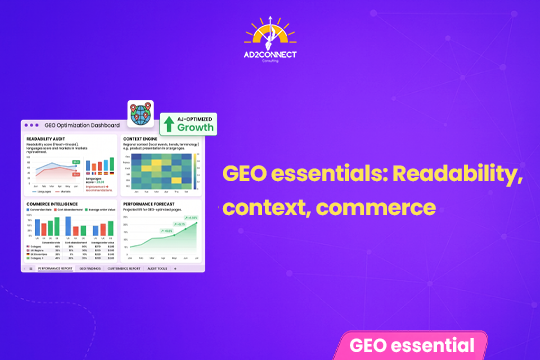
AI Overview Summary: GEO, or Generative Engine Optimization, rests on three essentials. Readability means writing so AI tools can quickly pull a clear answer from your content. Context means getting your brand name mentioned and recommended in AI answers, not just linked to. Commerce means making sure AI shopping agents can find, trust, and select your products. Businesses that master only one of these three risk staying invisible in AI-driven search, even with strong traditional SEO.
Table of Contents
- What Is GEO, and Why Should You Care?
- The Problem With Thinking SEO Is “Done”
- Essential 1: Readability — Writing So AI Can Understand You
- Essential 2: Context — Getting AI to Say Your Name
- Essential 3: Commerce — When AI Shops on Behalf of Customers
- The 3 GEO Essentials at a Glance
- Mistakes That Look Like Strategy
- How Ad2Connect Approaches GEO
- Key Takeaways
- FAQs
What Is GEO, and Why Should You Care?
Think about the last time you asked ChatGPT or Google’s AI Mode for a recommendation. Maybe you asked for “the best CRM for a small team” or “a good digital marketing agency near me.” You probably got two or three names back. Not a long list of links to click through.
That is the shift in one sentence. Search used to hand you a page of results and let you pick. AI now picks a short list for you. If your business is not on that short list, it simply does not exist in that moment.
Generative Engine Optimization, or GEO, is the set of practices that help your business get picked. It is not a replacement for SEO. It is what happens after SEO gets your content noticed, when the AI decides who to quote, mention, or recommend. GEO breaks down into three essentials: readability, context, and commerce.
The Problem With Thinking SEO Is “Done”
Many business owners believe that once their website ranks on Google, the job is finished. That belief no longer holds up.
Search engines used to reward the page that ranked highest. AI systems work differently. They reward the passage that answers the question most clearly, and they pull that passage from wherever it lives online — not necessarily from the page that ranks first. That means a competitor with a shorter, cleaner paragraph on a lower-ranking page can get quoted by ChatGPT, while your longer, better-ranking page gets skipped entirely. The reason is simple: the AI could not find one clean, confident answer inside it. This is the uncomfortable truth GEO is built around. Ranking and being cited are now two different achievements, and a business needs both.
That is why GEO is not one activity. It splits into three separate jobs, each needing a different kind of attention.
Essential 1: Readability — Writing So AI Can Understand You
Readability simply means: can an AI tool quickly pull a clear, correct answer out of your content? AI systems read in small chunks, not whole pages. If a chunk is confusing, they skip it.
Why AI Skips Confusing Content
AI tools like ChatGPT search the web, break pages into small blocks of text, and stitch together an answer from the clearest blocks they find. A paragraph that rambles, mixes topics, or buries the point in the middle gets passed over in favour of a paragraph that says one thing clearly.
Good old-fashioned SEO still matters here. If your page is not indexed, loads slowly, or has messy HTML, AI tools may never find it in the first place. Readability only matters once the content is discoverable.
Simple Ways to Make Your Content AI-Friendly
- Keep paragraphs short — one idea, under 250 words, per paragraph.
- Put your main point in the first sentence, not buried at the end.
- Use headings that match real questions people ask, like “How much does local SEO cost?”
- Avoid keyword stuffing. Natural, grammatically clean writing performs better with AI than forced repetition.
- Use the same terms consistently. Switching between “SEO agency,” “search agency,” and “SEO firm” in one article can confuse how AI groups your content.
Essential 2: Context — Getting AI to Say Your Name
This essential is different from the first. It is not about your content being quoted. It is about your brand name showing up when someone asks AI for a recommendation.
How AI Decides Which Brands to Mention
AI models learn by noticing patterns across millions of articles, forum posts, and reviews. If your brand keeps appearing next to certain words — say, “local SEO,” “Mumbai,” and “small business marketing” — the AI starts to associate your name with those ideas.
This is called co-occurrence. The more often your brand is mentioned correctly, in the right context, across trustworthy sites, the stronger that mental link becomes for the AI. It is very similar to how a person builds a reputation over years of word of mouth.
Building Your Brand’s AI Reputation
- Get featured in “Top 10” or “Best of” style comparison articles in your industry.
- Contribute expert quotes to relevant news sites and blogs.
- Stay active and genuinely helpful on forums like Reddit and Quora, where AI tools often pull real opinions from.
- Collect and respond to reviews consistently, since AI systems read review platforms too.
There is no paid advertising shortcut here. You cannot buy your way into an AI’s recommendation list the way you can buy a Google Ads slot.
Essential 3: Commerce — When AI Shops on Behalf of Customers
The third essential is the newest, and it matters most for businesses that sell products online. AI agents are starting to research, compare, and in some cases even complete purchases for users, not just suggest options.
What Changes When AI Buys on Your Behalf
Picture a customer telling ChatGPT, “Find me a good pair of running shoes under ?4,000.” The AI agent checks product data, prices, ratings, and stock. It narrows the choice down to two or three options. Your product either makes that shortlist or it does not. There is no second page for the customer to browse.
Getting Your Business “Agent-Ready”
- Keep product data (price, stock, specifications) accurate and consistent across your website, Google Merchant Center, and marketplaces.
- Add clear, fact-based product descriptions instead of vague marketing language.
- Use structured data (Schema markup) so AI systems can read your product details correctly.
- Actively collect and manage customer reviews, since AI agents weigh ratings heavily when picking between similar products.
The 3 GEO Essentials at a Glance
| Essential | Main Goal | Who Usually Owns It | Where It Shows Up |
|---|---|---|---|
| Readability | Get your content quoted or cited by AI | SEO & content teams | AI Overviews, ChatGPT answers, Perplexity |
| Context | Get your brand name recommended | PR, branding & content teams | “Best of” AI answers, comparison prompts |
| Commerce | Get your products selected and purchased | Ecommerce & product data teams | AI shopping agents, product shortlists |
Mistakes That Look Like Strategy
Some habits feel productive but quietly hurt your GEO efforts.
- “We already rank on Google, so we are covered.” Ranking gets you discovered. It does not guarantee AI will quote or recommend you.
- Stuffing pages with keywords for AI. AI models are trained to spot unnatural repetition. It lowers trust in your content rather than boosting it.
- Ignoring reviews and forums. Many businesses focus only on their own website and skip Reddit, Quora, and review sites — exactly where AI tools often look for honest opinions.
- Treating product listings as an afterthought. Vague descriptions and outdated stock data quietly remove you from AI shopping shortlists.
- Writing long, unfocused pages “for SEO.” A 3,000-word page with the answer buried in paragraph 40 rarely gets cited. A clear, well-organised 800-word page often does.
How Ad2Connect Approaches GEO for Mumbai Businesses
GEO is still new, and most agencies are only beginning to adapt their playbooks. At Ad2Connect, we build all three GEO essentials into the same foundations that already drive strong search performance.
We are one of the more established Top SEO Company In Mumbai, India. Our content and technical teams structure pages the way both search engines and AI systems prefer. We write short, clear paragraphs with the answer stated upfront, backed by consistent, well-linked internal pages. This pairs naturally with our work as a Best Local SEO Company in Mumbai. Local intent queries are exactly where AI answers are being tested most heavily right now.
Getting mentioned by AI also depends on brand reputation beyond your own website. As a Leading branding agency in India, we help clients build consistent, recognisable positioning. This is the kind of positioning that AI models pick up on across articles, reviews, and comparison content. It is the same co-occurrence pattern that gets a brand recommended instead of overlooked. Our team, working as a Performance Marketing agency, also keeps a close eye on how AI-driven discovery is starting to affect paid and organic results together. To see how these pieces connect for your business, visit our About Us page.
Key Takeaways
- GEO has three essentials: readability, context, and commerce.
- Traditional SEO is still the foundation — GEO builds on top of it, not instead of it.
- Short, clearly structured content with the answer stated upfront gets cited more often by AI tools.
- Brand mentions on trusted third-party sites matter as much as your own website content.
- Accurate, consistent product data is essential if you sell products online, as AI shopping agents are already comparing and selecting on customers’ behalf.
AI is already deciding which brands your customers hear about. The businesses that adapt their content, reputation, and product data now will be the ones showing up in those answers a year from now.