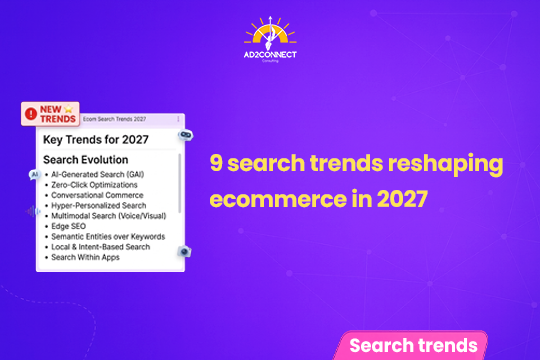
9 Search Trends Reshaping Ecommerce in 2027
Everyone is telling ecommerce brands to chase AI search. The real data tells a very different, more useful story about where the traffic and revenue actually come from.
AI Overview Summary: Google search is still growing for ecommerce, and traditional SEO remains a top revenue driver. AI Overviews are appearing in more shopping searches, but AI assistants like ChatGPT still send very little traffic compared to Google. That said, AI-referred traffic converts better than regular organic traffic. Google Shopping quietly delivers strong revenue for many stores. Agentic checkout, where AI buys products directly, is still mostly hype for now. The brands that win in 2027 will be the ones who keep doing SEO and Shopping well, while quietly preparing for AI search instead of chasing every new headline.
Table of Contents
- Why Ecommerce Search Feels So Confusing Right Now
- Trend 1: Google Search Is Still Growing, Not Dying
- Trend 2: Traditional SEO Still Drives Real Revenue
- Trend 3 & 4: AI Overviews Are Rising, AI Mode Is Still Small
- Trend 5 & 6: ChatGPT Is Popular, But Sends Little Traffic
- Trend 7: AI Traffic Converts Better, Even If It’s Smaller
- Trend 8: Don’t Ignore Google Shopping
- Trend 9: Agentic Checkout Isn’t Ready Yet
- Where Ecommerce Traffic Actually Comes From
- Mistakes That Look Like Strategy
- How Ad2Connect Approaches Ecommerce Search
- Key Takeaways
- FAQs
Why Ecommerce Search Feels So Confusing Right Now
If you run an online store, you have probably heard two opposite things in the same week. One person tells you Google search is dying and you must rush into AI search. Another tells you AI search barely matters and you should keep doing what you have always done.
Both cannot be fully right. The only way to know what actually matters is to look at real traffic and revenue numbers, not headlines. A recent industry analysis did exactly that. It studied millions of search queries and a panel of 75 ecommerce stores earning between $1 million and $20 million a year. Here is what the data actually shows, explained simply.
Trend 1: Google Search Is Still Growing, Not Dying
Despite the noise around ChatGPT and other AI tools, plain old Google search for products is still growing. Searches for high-intent, ready-to-buy terms like “air fryer” or “protein powder” rose by roughly 2.2% over the past year.
In simple terms, more people are still typing product searches into Google than ever before. AI has not replaced this habit. It has added to it.
Trend 2: Traditional SEO Still Drives Real Revenue
Growth in searches only matters if it turns into sales. Looking at actual store revenue, non-branded organic search remains one of the strongest revenue channels for ecommerce stores. This is the traffic that comes from ranking well, not from people typing your brand name directly. It sits second only to paid search.
This confirms something simple. Solid, well-optimized SEO is still one of the most reliable ways to grow an online store. It has not been replaced. It has just gained new neighbours.
Trend 3 & 4: AI Overviews Are Rising, AI Mode Is Still Small
Google’s AI Overviews, the AI-written summaries that sometimes appear above regular search results, were barely present in shopping searches a year ago, showing up in roughly 1 out of every 100 product searches. That number has climbed sharply since then, now appearing in close to 1 out of every 4 shopping searches. This means a growing share of product-related clicks may never reach a traditional listing at all. Yet Google’s “AI Mode” is used by only a tiny sliver of searchers, despite heavy promotion on the homepage and in Chrome. This suggests Google may be leaning more on quick AI summaries inside normal search. It may not be pushing everyone into a whole new AI-only mode. For store owners, the practical takeaway is this: watch your AI Overview appearances, not AI Mode adoption.
If your organic traffic is dropping while your keyword rankings stay strong, an AI Overview sitting above your listing could be quietly absorbing the clicks.
Trend 5 & 6: ChatGPT Is Popular, But Sends Little Traffic
ChatGPT remains the most-used AI assistant by far, with Gemini and Claude gradually catching up. But popularity in conversation does not automatically mean shopping traffic.
Across the studied stores, AI assistants combined sent only about 1.6% of total search traffic and revenue. Google, by comparison, still sends the overwhelming majority.
Tools like Perplexity and Copilot are used even less for shopping in most markets, including India. For now, spending heavy budget chasing visibility on every AI tool is not where the return lies.
Trend 7: AI Traffic Converts Better, Even If It’s Smaller
Here is the twist. Even though AI assistants send far less traffic, that traffic converts better. It converts around 19% higher than regular non-branded organic search.
The likely reason is simple. AI tools often do the early research work for the shopper. They compare options and narrow choices before the person even visits your site. By the time they click through, they are closer to ready to buy.
Trend 8: Don’t Ignore Google Shopping
Google Shopping listings are the product grids with images and prices. They often get less attention than regular SEO. That is a mistake.
Organic Shopping listings converted around 60% higher than regular non-branded search in the studied data. Many shoppers seem to prefer browsing visual product grids over scanning a list of blue links.
If your store has not set up its free Google Shopping listings properly, this is a quick win worth prioritising.
Trend 9: Agentic Checkout Isn’t Ready Yet
You may have read about AI agents that can buy products directly on a shopper’s behalf, sometimes called agentic commerce. Two major technical systems support this: one built by OpenAI and Stripe, and another led by Google and Shopify.
In practice, adoption has been slow. OpenAI actually shut down its instant-checkout feature after only a small number of merchants ever used it. Direct AI purchasing today remains limited mostly to a handful of large retailers.
For most ecommerce brands, rushing to build agentic checkout infrastructure right now is not the priority. It is worth watching, not worth rebuilding your store around just yet.
Where Ecommerce Traffic Actually Comes From
| Channel | Share of Traffic | Conversion Trend | 2027 Priority |
|---|---|---|---|
| Non-branded Organic Search | High, steady | Solid baseline | Keep investing |
| Google Shopping (organic) | Moderate | ~60% higher than organic | Underused — fix now |
| AI Assistants (ChatGPT, etc.) | Low (~1.6%) | ~19% higher than organic | Prepare, don’t overinvest |
| Agentic / AI Checkout | Very low | Too early to measure | Monitor only |
Mistakes That Look Like Strategy
Some habits feel forward-thinking but end up wasting time and budget.
- Abandoning SEO because “Google is dying.” The data shows the opposite. Non-branded organic search is still a top revenue channel.
- Chasing visibility on every AI tool at once. Most AI assistants beyond ChatGPT and Gemini send negligible ecommerce traffic right now.
- Ignoring Google Shopping. Free Shopping listings quietly outperform regular organic search on conversion rate for many stores.
- Rebuilding your store for agentic checkout too early. The infrastructure is still experimental and limited to a handful of large retailers.
- Treating AI Overviews as a reason to give up on rankings. Ranking well is still what gets you considered for citation inside those AI summaries in the first place.
How Ad2Connect Approaches Ecommerce Search
Ecommerce search is not choosing between SEO and AI. It is getting the fundamentals right while quietly preparing for what comes next.
We work as a Top SEO Company And Agency In Mumbai, India. Our approach for ecommerce clients starts with the channel the data still favours most: solid, well-optimized organic search. This pairs with our work as a Best Local SEO Company in Mumbai. Store listings and local intent searches are not left on the table. These still convert reliably for brands serving Mumbai and nearby markets.
Google Shopping optimisation and paid-organic balance fall under our work as a Performance Marketing agency. We help ecommerce clients set up and refine Shopping feeds correctly, rather than leaving free revenue on the table. Product messaging affects both human shoppers and AI systems evaluating it. Our team, working as a Leading branding agency in India, helps keep that messaging clear, consistent, and trustworthy. To see how these pieces work together for your store, visit our About Us page.
Key Takeaways
- Google search for products is still growing — it has not been replaced by AI.
- Non-branded organic search remains one of the top revenue channels for ecommerce stores.
- AI Overviews are appearing in far more shopping searches than a year ago and may be quietly reducing clicks.
- AI assistants send little traffic today, but that traffic converts noticeably better.
- Organic Google Shopping listings convert significantly higher than regular search — don’t ignore them.
- Agentic checkout (AI buying directly) is still early and limited mostly to a few large retailers.
The brands that come out ahead in 2027 won’t be the ones chasing every new AI headline. They will be the ones who protect what already works while calmly preparing for what’s next.