Measure AEO Better with This 3-Layer Framework
A simple, no-jargon way to prove whether your AI search visibility is actually driving business results.
By Snehal Singh | Updated: September 23, 2026
AEO, short for Answer Engine Optimization, means getting your brand mentioned inside AI answers on tools like ChatGPT, Google AI Overviews, and Perplexity. The problem is that these mentions often do not create a click, so normal analytics tools cannot see them. To measure AEO better, use a 3-layer framework that tracks AI visibility, downstream traffic, and real business outcomes together. This gives you a credible way to prove AEO is working, even without a perfect, click-by-click trail.
Table of Contents
- 1. What Is AEO Attribution?
- 2. Why AEO Is So Hard to Measure
- 3. The 3-Layer Framework to Measure AEO
- 4. A Quick Example: The 3 Layers in Action
- 5. How to Set Up Tracking for Each Layer
- 6. Traditional Attribution vs. the 3-Layer Framework
- 7. Mistakes That Look Like Strategy
- 8. How Ad2Connect Approaches AEO Measurement
- 9. Key Takeaways
- 10. Frequently Asked Questions
What Is AEO Attribution?
AEO stands for Answer Engine Optimization. It means shaping your content so AI tools like ChatGPT, Google AI Overviews, Gemini, and Perplexity mention your brand when someone asks a related question.
Attribution means finding which marketing effort caused a result, like a sale or a signup.
Put the two together, and AEO attribution answers one hard question: did an AI mention of your brand actually lead to more business?
That question sounds simple. In practice, it is one of the trickiest problems in marketing today.
Why AEO Is So Hard to Measure
Traditional analytics tools were built around clicks. Someone clicks a link and lands on your site. The tool then logs where they came from.
AI answers break that pattern. A person can ask ChatGPT which agency to hire, read a full answer that names your brand, and never click a link at all.
This creates what many marketers now call the dark funnel, and it matters far more than it sounds like it should, because the buyer’s decision often gets shaped entirely inside that invisible AI conversation, long before your analytics software ever records a single event; the person forms an opinion about which brands feel credible, remembers a name or two from the answer, and only later opens a browser and searches for that brand directly, which your tools then log as plain “branded search” or “direct traffic” with no hint that an AI answer is what actually started the whole journey, so if you only trust the numbers your dashboard shows you, you will consistently and confidently undercount the real value that AEO is quietly generating for your business.
This is exactly why one metric can never tell the full AEO story. You need several layers of evidence working together.
The 3-Layer Framework to Measure AEO
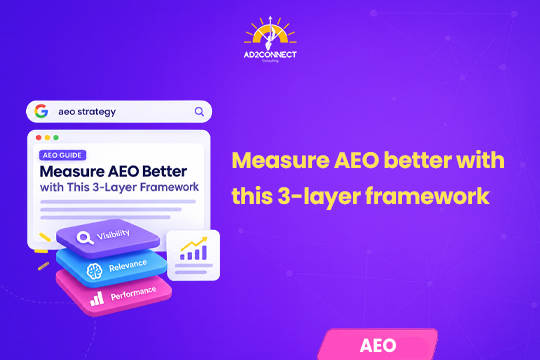
Instead of chasing one perfect number, the smarter move is to build a case using three connected layers of evidence.
Layer 1: AI Visibility Signals
This is the layer closest to the AI answer. It includes three signals:
- Citation rate: How often your brand gets mentioned in a set list of relevant queries.
- Mention rate: How often your brand comes up at all, even loosely.
- Share of voice: How your mentions compare to your competitors on the same queries.
Think of this layer as your starting evidence. It tells you if AI tools know your brand exists for topics that matter to you.
Layer 2: Downstream Traffic Signals
This layer looks at what happens after someone sees your brand inside an AI answer.
- Branded search lift: More people searching your company name directly.
- Direct traffic lift: More visitors typing your website address straight into their browser.
- AI-referral sessions: Visits that arrive with a traceable link from an AI platform.
These signals sit in the middle. They are not perfect proof, but a steady rise in branded search after an AEO push is strong supporting evidence.
Layer 3: Business Outcome Signals
The final layer ties everything back to revenue and real results, using three checks:
- Self-reported attribution: Asking new leads directly, “How did you hear about us?”
- Pipeline correlation: Comparing deal timing against your AEO content and citation timeline.
- Conversion quality: Checking if AI-referred visitors convert better or worse than other channels.
Together, these three layers build a case that is honest about what can be proven and what can only be reasonably guessed.
A Quick Example: The 3 Layers in Action
Picture a small marketing agency. Six months ago, nobody at the agency knew if AI tools even mentioned their name.
They started checking Layer 1 first. Each month, they typed 40 real customer questions into ChatGPT and Perplexity. In month one, their brand showed up in 8 of those answers. By month four, it showed up in 22.
Next, they watched Layer 2. Branded search traffic for their company name rose by 30 percent over the same period. Direct visits to their homepage also climbed steadily.
Finally, they checked Layer 3. On their contact form, a new field asked, “How did you hear about us?” Four new leads that month typed some version of “I asked ChatGPT” or “an AI tool mentioned you.”
No single layer proved AEO was working on its own. Together, all three painted a clear and convincing picture.
How to Set Up Tracking for Each Layer
You do not need a big analytics team to start. A basic setup can give you useful data within a few weeks.
For Layer 1
Pick 30-50 real questions your customers ask. Check monthly if your brand shows up when those questions get asked on ChatGPT, Perplexity, and Google AI Overviews.
For Layer 2
In Google Analytics, watch branded search volume and direct traffic trends month over month. A steady upward trend, timed close to your AEO work, is a meaningful signal.
For Layer 3
Add a simple “How did you hear about us?” field to your contact or demo request forms. Over time, this becomes one of your most reliable data sources.
Traditional Attribution vs. the 3-Layer Framework
| What You Need to Know | Traditional Click Attribution | 3-Layer AEO Framework |
|---|---|---|
| Needs a click to register | Yes, always | No, it works even for zero-click AI mentions |
| Shows AI citation activity | Not at all | Yes, through Layer 1 tracking |
| Connects to real revenue | Sometimes, if the path is short | Yes, through Layer 3 self-reported data |
| Best suited for | Paid ads, simple funnels | AI search, long or hidden buyer journeys |
Mistakes That Look Like Strategy
Some AEO measurement habits feel thorough but quietly waste time. They hide the real picture instead of showing it.
- Reporting only Layer 1 data. Citation rate alone can make AEO look small, since it never shows business impact.
- Waiting for a perfect attribution model. AEO will likely never offer perfect, click-by-click proof. A good estimate beats no estimate.
- Reacting to daily swings. AI visibility naturally moves up and down each day. Judge it over weeks and months, not single days.
- Treating every AI platform the same. ChatGPT, Perplexity, and Google AI Overviews behave differently and deserve separate tracking.
- Skipping the self-reported data field. It is the easiest layer to add, yet the one most teams forget to set up.
How Ad2Connect Approaches AEO Measurement
At Ad2Connect, AEO measurement is treated as part of search strategy, not a side project added at the end.
As one of the Best SEO Agency in Mumbai, our team builds citation tracking into the same reports clients already use for organic search, so AI visibility never sits in a silo.
Branded search lift is one of the clearest signals we have. As a Leading performance marketing agency in Mumbai, we connect paid and organic data to spot AEO-driven demand early.
As a Boutique digital marketing agency in Malad, Mumbai, we keep this process hands-on and transparent. Clients always know which numbers are proven and which are fair estimates.
The goal is always the same: a measurement setup that is honest, practical, and useful for real decisions.
Key Takeaways
- AEO attribution means figuring out if AI mentions of your brand actually drive business results.
- Traditional analytics miss most AEO impact because it often happens without a click.
- Layer 1 tracks AI visibility: citation rate, mention rate, and share of voice.
- Layer 2 tracks downstream signals: branded search lift and direct traffic lift.
- Layer 3 connects everything to business outcomes through self-reported data and pipeline correlation.
- A good three-layer estimate beats waiting for one perfect number.
If your team can only see AEO through a citation count right now, you are missing most of the story. Start adding traffic and business outcome data, and the real value tends to show up fast.