
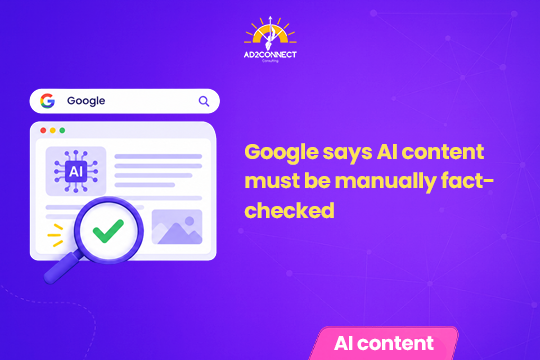
Google Says AI Content Must Be Manually Fact-Checked
Artificial Intelligence is now widely used in digital marketing to create blogs, product descriptions, and website content. However, Google has recently made an important clarification that changes how businesses should use AI.
Google now clearly states that all AI-generated content must be manually reviewed and fact-checked before publishing to ensure accuracy and trustworthiness.
This update is not just a small guideline change. It directly impacts SEO strategies, content marketing workflows, and how agencies like a Top SEO Company in Mumbai, India or a Creative Advertising Agency in Mumbai manage content quality.
What Google Actually Said About AI Content
Google explained that AI tools do not “retrieve facts” like a search engine. Instead, they generate text based on patterns and predictions.
Because of this, AI systems can sometimes produce:
- Incorrect information
- Outdated data
- Misleading statements
- “Hallucinated” facts
To solve this, Google strongly advises publishers to manually fact-check all AI-generated content before it goes live.
This includes not only blog articles but also SEO elements such as titles, meta descriptions, structured data, and image alt text.
For businesses relying on Best SEO services in Mumbai or Best Local SEO Services in India, this is a critical shift in how content must be created and reviewed.
Why This Update Is Important for SEO
This update directly connects to how Google evaluates content quality.
Search engines are becoming more focused on:
- Content accuracy
- User trust
- Real human value
- Authority of information
If a website publishes unverified AI content, it risks:
- Lower search rankings
- Reduced organic traffic
- Loss of trust from users
- Poor engagement signals
For industries like Best Branding Agency in Mumbai, Performance Marketing agency in Mumbai, and Best Digital Marketing Agencies In Mumbai, where competition is high, even small content errors can affect brand reputation.
Google is basically sending a clear message:
AI can assist, but humans are responsible.
Impact on Businesses and Marketing Agencies
This update is especially important for agencies and businesses that rely heavily on automation tools.
Many companies use AI for speed, but without proper review, the content may not align with SEO or brand standards.
For example:
- A Boutique digital marketing agency in Mumbai, Malad using AI-generated blogs still needs human editors to verify accuracy
- A Leading branding agency in India must ensure brand messaging is consistent and factually correct
- A Best Performance Marketing Agency in Mumbai, India must ensure landing page content is trustworthy and conversion-ready
This is where a structured content workflow becomes essential.
What Businesses Should Do Now
To stay aligned with Google’s expectations, businesses should adopt a hybrid content system:
1. Use AI for Speed, Not Final Output
AI can help generate drafts, ideas, and outlines quickly.
2. Add Human Fact-Checking
Every piece of content should be reviewed by an editor or SEO expert.
3. Verify All Claims
Statistics, dates, and factual statements must be cross-checked.
4. Maintain Brand Consistency
Content should match your tone, whether you’re a Creative Brand Agency in Mumbai or a Best Local SEO Company in Mumbai.
5. Optimize for Users, Not Just Search Engines
Google rewards content that is helpful, clear, and trustworthy.
How This Affects SEO Strategy in 2026
SEO is no longer just about keywords and backlinks. It is now deeply connected to content authenticity and reliability.
Businesses focusing on terms like:
- Best SEO Agency in Mumbai
- Top SEO Company And Agency In Mumbai, India
- Best Digital Marketing Agency in Malad
- Top Creative Agencies in Mumbai
must ensure their content is not only optimized but also verified for accuracy.
Google’s update reinforces a simple truth:
Quality always beats quantity.
One Long Insight
The biggest shift in this Google update is not just about AI usage—it is about accountability in content creation. While AI tools have made it easier than ever to produce large volumes of content in seconds, Google is now clearly pushing businesses toward a more responsible approach where human oversight becomes non-negotiable. This means every article, landing page, or SEO asset created using AI must go through a structured review process to ensure that facts are correct, messaging is consistent, and the content genuinely provides value to users. Over time, businesses that ignore this step may see declining rankings and reduced trust, while those that combine AI efficiency with human expertise will build stronger authority, better engagement, and more sustainable SEO growth.
Final Thoughts
Google’s message is simple but powerful: AI content is acceptable, but only when it is accurate, reviewed, and trustworthy.
For brands working with a Best SEO Agency in Mumbai or a Creative advertising agency in Mumbai, this is the right time to refine content workflows and prioritize quality over speed.
In the end, SEO success will depend on one key factor:
Trust built through verified, human-reviewed content.