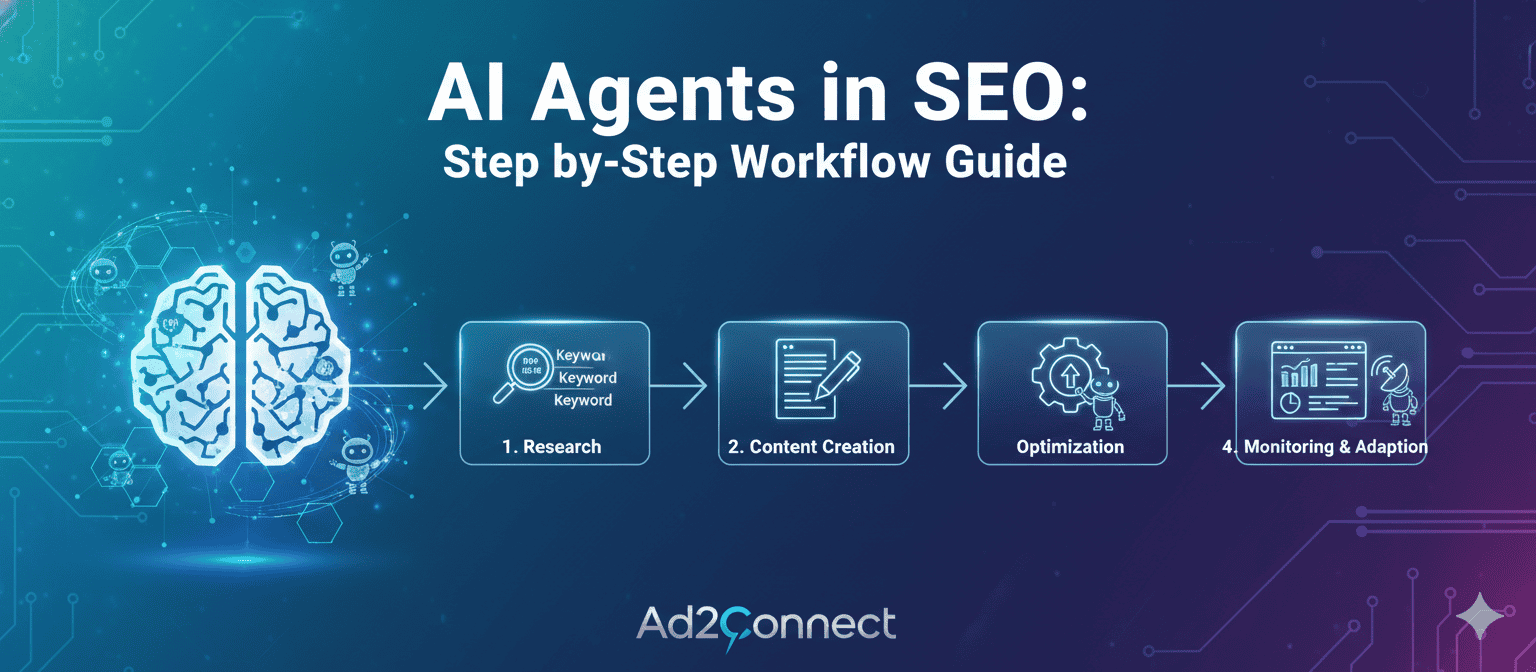
AI Agents in SEO: Step-by-Step Workflow Guide
SEO is no longer just about keywords and backlinks. It is about understanding intent, entities, and user behavior at scale. This is where AI agents in SEO become essential. Unlike basic automation tools, AI agents can observe data, reason over patterns, and recommend or execute actions that improve search visibility continuously.
This matters because search engines now reward content that is helpful, structured, and aligned with user needs. Manual SEO processes struggle to keep up with frequent algorithm updates, large content libraries, technical complexity, and multi-channel visibility. AI agents provide a practical way to move from reactive optimization to continuous improvement.
This guide explains a real-world workflow for using AI agents in SEO, from research and planning to optimization and performance feedback.
What Are AI Agents in SEO?
AI agents are task-driven systems that combine machine learning, natural language processing, and automation. In SEO, their purpose is to monitor data from search platforms, identify opportunities or risks, suggest or perform optimizations, and learn from performance outcomes.
They support modern optimization models such as AI Optimization, Topical Entity Optimization, Visibility Engine Optimization, Conversion Rate Optimization, and Local Entity Optimization. Instead of replacing SEO professionals, AI agents enhance human decision-making by handling scale while people focus on strategy and quality.
Step-by-Step AI Agent SEO Workflow
Step 1 – SERP, Keyword, and Entity Research
The first role of an AI SEO agent is discovery. It scans search results, competitor pages, and query trends to identify primary and secondary keywords, user intent patterns, and topical entities.
Rather than only collecting keywords, the agent maps relationships such as “AI agents,” “automation,” “SEO tools,” and “search optimization.” This allows the content strategy to align with how search engines understand topics.
Actionable tip: Configure the agent to detect intent changes. If a keyword shifts from informational to commercial, update your content accordingly.
Step 2 – Content Planning and Topical Authority
Once research is complete, the AI agent builds a content framework by detecting gaps, grouping topics into clusters, and proposing internal linking paths. Instead of isolated blog posts, this approach creates topical authority by answering related questions in depth.
This stage supports Topical Entity Optimization by ensuring your site reflects a complete knowledge structure around your subject.
Practical strategy: Let the agent generate content briefs that include suggested headings, related entities, key questions, and intent labels. This keeps writers focused on usefulness instead of keyword density.
Step 3 – On-Page Optimization and UX Alignment
AI agents improve pages by analyzing structure, clarity, and relevance. Common tasks include rewriting headings for intent matching, adding semantic keywords naturally, improving internal links, and identifying schema opportunities.
They also evaluate user experience signals such as scroll depth, time on page, readability, and mobile layout issues.
Accessibility best practices:
- Use logical heading order from H1 to H3.
- Write descriptive anchor text instead of “click here.”
- Ensure readable font sizes for mobile users.
- Add meaningful alt text to images.
- Break content into short paragraphs and lists.
Optimizing for people improves behavioral signals that support search performance.
Step 4 – Technical SEO Monitoring
AI agents are especially effective for technical SEO because they work continuously. They can detect crawl errors, monitor indexation, identify thin pages, and track page speed and Core Web Vitals.
Instead of waiting for monthly audits, the agent runs checks daily and triggers alerts when issues appear.
Automation logic example: If page speed drops below a defined threshold, the agent flags the page, recommends fixes such as image compression, and re-tests after changes.
Step 5 – Performance Feedback and Learning Loop
This is where AI agents differ from static tools. They analyze rankings, click-through rates, engagement, and conversions. Based on results, they suggest section expansions, content pruning, new subtopics, or title and meta description tests.
This creates a feedback loop that supports long-term growth instead of one-time optimization.
Practical Strategies You Can Apply Today
Build a Micro-Agent System
Instead of one complex system, use several focused agents such as a research agent, a content optimization agent, a technical audit agent, and a monitoring agent. This improves accuracy and makes troubleshooting easier.
Optimize for Both AI and Humans
Pages should be easy to summarize, easy to scan, and easy to act on. Use clear definitions, bullet points, structured data, and visual hierarchy. If a machine can understand your page quickly, a human will too.
Stay Aligned With Search Quality Guidelines
AI agents should help produce original insights, real examples, and task-oriented content. Avoid automated rewriting of competitors, thin pages, and over-optimization. Search engines reward usefulness, not automation itself.
GEO Targeting and Local Adaptation
AI agents can localize SEO by detecting geo-intent queries, optimizing local entities, and managing citations and reviews. Agencies in the US and UK can use AI agents to adapt content for regional terminology, local search features, and market-specific competition. This strengthens Local Entity Optimization and improves map and localized visibility.
Conclusion
AI agents in SEO represent a shift from static optimization to intelligent, adaptive workflows. By using them for research, content planning, technical monitoring, and performance learning, you gain faster insights, better topical coverage, stronger technical foundations, and continuous growth.