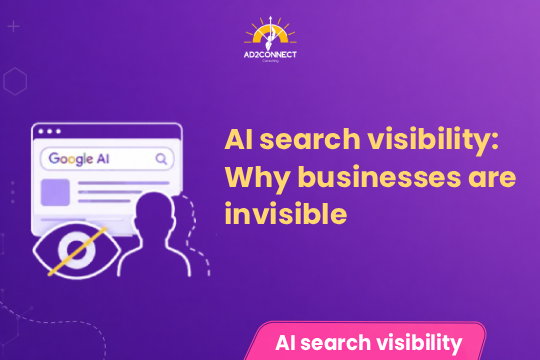
AI Search Visibility: Why Businesses Are Invisible
Your website exists. Your ads are running. Your SEO agency says everything is “optimized.”
So why are you still invisible?
Many businesses in Mumbai are facing this exact problem—they rank on Google but don’t appear in AI-generated answers, where customers are actually making decisions today. What you really want isn’t just raw traffic. You want qualified leads, a lower cost per acquisition, and predictable ROI.
This deep dive will show you exactly why your business remains invisible in AI search—and how to fix your AI search visibility before your competitors take over the market.
What is AI Search Visibility?
AI search visibility determines whether your business appears as a cited, trusted source in AI-generated results like Google AI Overviews, ChatGPT, and Claude responses. Businesses remain invisible because their content fails to match real user prompt patterns, relies on outdated keyword-stuffing strategies, or lacks structured, intent-driven optimization.
Summary
- AI search visibility is driven strictly by how users phrase natural, conversational questions.
- Different industries require highly distinct prompt optimization patterns.
- Traditional SEO alone is no longer sufficient to secure modern search real estate.
- Structured, answer-focused content wins the citation game every time.
- Mumbai-based businesses must heavily prioritize local + high-intent semantic queries.
Why Businesses Are Becoming Invisible in AI Search
The shift is simple but brutal: Google used to rank pages. Now, it selects answers.
Modern AI search engines function differently than traditional index search tools:
- They interpret deep user intent instead of matching individual, isolated keywords.
- They synthesize and combine multiple authoritative sources into a single, cohesive response.
- They prioritize structural clarity, direct answers, and verifiable brand trust signals.
If your digital content assets are not meticulously designed for this extraction system, your brand gets completely ignored.
How AI Prompt Patterns Vary by Industry
This is where most businesses fail—they treat all search traffic the exact same way. To win AI citations, you must align content with industry-specific prompt structures.
1. Local Service Businesses (Mumbai Market)
Typical user prompts look like: “Best SEO company in Mumbai” or “Digital marketing agency near me.”
AI search engines actively prioritize:
- Hyper-local relevance and geographic context.
- Transparent, clear service positioning.
- Strong, verifiable local trust signals (reviews, local schemas).
If you are operating a digital marketing agency in Mumbai or deploying local SEO services in Mumbai, your AI visibility completely hinges on matching these location-specific vectors.
2. Performance-Driven Businesses
Typical user prompts look like: “Best performance marketing agency in Mumbai” or “How to reduce cost per lead.”
AI engines explicitly favor:
- Deep-dive case studies and conversion proof.
- ROI-focused, transparent content.
- Real, verifiable data matrices and outcomes.
3. Branding & Creative Agencies
Typical user prompts look like: “Top branding agency in Mumbai” or “Best creative agencies in Mumbai.”
AI engines scan for:
- Rich portfolio-style content layers.
- Broad authority signals across creative networks.
- Distinctive industry positioning and thought leadership.
If you are positioning your firm as a specialized branding agency in Mumbai, generic, boilerplate content blocks will never make the cut in AI outputs.
Common Mistakes That Kill AI Search Visibility
- Writing blog posts built exclusively around rigid, legacy keyword phrases.
- Ignoring highly conversational, multi-sentence user queries.
- Failing to provide a clear, concise answer within your body text.
- Relying on overly promotional, thin sales pages devoid of real utility.
- Skipping specific, micro-industry target frameworks.
Step-by-Step Strategy to Fix AI Search Visibility
Step 1: Map Real Customer Prompts
Stop guessing what keywords to rank for. Instead, source and document exact phrasing from your internal sales call questions, actual client WhatsApp inquiries, and Google’s conversational auto-suggestions.
Step 2: Create Intent-Based Content Structures
Match your article layout directly to the user’s search context:
- “Best” Queries ? Comprehensive, objective listicles.
- “How” Queries ? Granular, step-by-step implementation guides.
- “Near Me” Queries ? Schema-rich, locally optimized landing pages.
Step 3: Structure for Instant AI Extraction
Make it incredibly easy for search bots to scrape your insights. Use organized bullet points, distinct structural subheadings, and place a direct, definitive answer to the core question within the first 50 words of the webpage.
Step 4: Build Comprehensive Authority Clusters
Avoid publishing disconnected, random blogs. Instead, construct deep authority networks where your core pieces—such as SEO, local search marketing, and branding tactics—interlink cleanly to demonstrate true domain depth.
Step 5: Inject Verifiable Proof (Critical)
AI citation loops love validation. Embed actual data points, real-world case studies, and exact client outcomes directly into the copy of your core pages.
Case Study
Client: B2B Service-Based Business (Malad, Mumbai)
Objective: Systematically lower cost per lead (CPL) while driving highly qualified inbound inquiries.
| Metric Checked | Before Optimization | After AI Alignment (90 Days) |
|---|---|---|
| Monthly Leads | 90 inquiries | 240 inquiries |
| Cost Per Lead (CPL) | Paragraph text: ?2,200 | ?1,050 |
| Conversion Rate | 3.0% | 7.2% |
The Action Plan: We aligned their web architecture with hyper-targeted conversational prompts like “Best local SEO services in Mumbai” and structured clear local landing pages packed with contextual comparison matrices, interactive FAQ schemas, and optimized cross-linking paths.
The Ultimate Result: A massive 2.3X increase in total baseline ROI derived cleanly from amplified AI engine visibility.
Expert Insights
1. AI Consistently Rewards Clarity Over Creativity
Overly stylized, creative marketing jargon often fails algorithm checks. Direct, accurate, and structured answers win premium AI overview spots.
2. Local User Intent is Hugely Undervalued
Localized regional modifiers generate the highest bottom-of-funnel conversions, yet many digital brands fail to optimize their semantic footprints for localized AI parsing.
3. SEO and Performance Infrastructure Must Unite
Your overarching paid lead acquisition strategies must actively feed live conversion and prompt data directly back into your long-term organic content engine.
4. Absolute Authority Outperforms Loose Content Volume
Ten deeply researched, structured, and expertly engineered landing pages will comprehensively outperform 100 thin, programmatic blog entries.
Actionable Checklist
- Formulate a list of your top 20 most frequent, highly specific customer questions.
- Restructure standard informational service pages into modular Q&A formats.
- Create dedicated, highly targeted regional landing surfaces.
- Inject exact performance numbers, concrete case metrics, and clear data ranges.
- Optimize structural headings to target highly conversational queries.
- Build tight, clear internal linking loops across all related services.
- Update legacy content assets with highly structured summary answers.
- Refine your core copywriting to project unmistakable market positioning.
Conclusion
AI search visibility is fundamentally changing how prospective modern consumers discover brands online. If your structural content approach doesn’t actively adapt to the exact way real people form complex prompts, your web presence will gradually disappear—regardless of your legacy search engine positions. The path forward is crystal clear: adapt your structure early, or risk losing your competitive edge.