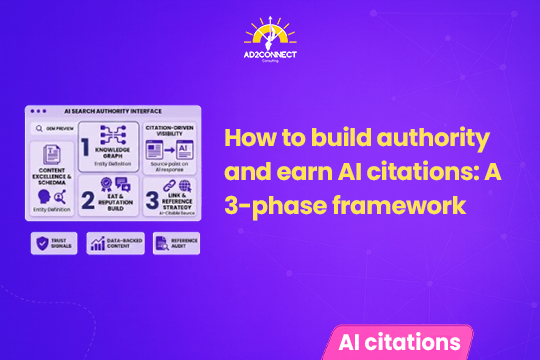
How to Build Authority and Earn AI Citations: A 3-Phase Framework
Ranking on Google no longer guarantees you show up when someone asks ChatGPT or Gemini for a recommendation. Here’s the process that actually earns you a mention — and a link.
By Snehal Singh | Published: August 23, 2026
AI Overview Summary
Earning AI citations — being named and linked to as a source in tools like ChatGPT, Perplexity, and Gemini — takes more than good content. It requires three things working together: technical accessibility so AI crawlers can actually read your pages, fresh brand-informed content that gives AI systems something accurate to learn from, and third-party validation through digital PR and outreach that builds the trust no brand can manufacture on its own. Most top-of-funnel brand mentions in AI search come from third-party content, not owned websites, which is why outreach and earned coverage matter as much as on-site SEO. Skip any one phase and the other two lose their power.
Table of Contents
- Getting Mentioned Isn’t the Same as Getting Cited
- Phase 1: Make Your Pages Easy for AI to Read
- Phase 2: Publish Fresh, Brand-Informed Content
- Phase 3: Earn Third-Party Trust Through Digital PR
- Why the Three Phases Compound Together
- Mention vs. Citation: What’s the Difference
- Mistakes That Look Like Strategy
- How Ad2Connect Approaches AI Search Visibility for Clients
- Key Takeaways
Getting Mentioned Isn’t the Same as Getting Cited
Not every appearance in an AI answer works the same way, and confusing the two wastes effort.
A mention is when an AI names your brand inside its answer, with no link back to your site. A citation is when the AI links directly to your page as the source. Citations drive real traffic. Mentions build recall, but send nobody your way.
This distinction matters more than it first appears, because the instinct for most businesses is to treat any AI appearance as a win — but a brand that only earns mentions is invisible in every way that matters for actual leads, while a brand that earns citations gets a direct, clickable path from an AI answer straight to its own website; the gap between the two isn’t about writing better content alone, it comes down to whether external, independent sources also talk about you, since AI systems weigh third-party validation heavily when deciding which brand actually deserves the link rather than just the name-check, and that’s precisely the piece most companies skip because it takes longer and looks less like traditional SEO work.
Phase 1: Make Your Pages Easy for AI to Read
This phase leans on classic SEO and basic user experience — the fundamentals still matter, they just serve a new audience now: AI crawlers.
What this looks like in practice:
- Clear, logical site navigation that both humans and bots can follow easily.
- Machine-readable page structure with proper heading tags.
- Updated product pages, blog content, and company profile pages that are accurate and current.
- Short “key takeaways” summaries added to your most popular articles.
- Product pages structured with clear headings, feature bullets, and comparisons.
If an AI crawler can’t easily parse your page, none of your content ever gets the chance to be cited — no matter how good it is.
Phase 2: Publish Fresh, Brand-Informed Content
Search engines have always rewarded fresh content. AI systems reward it too, but for a different reason: they need current, accurate information to describe your brand correctly.
Your own website is where the real “source of truth” about your brand lives. If your content is outdated or vague, AI tools have nothing solid to learn from.
This phase splits into two practical parts:
- Fresh content — new articles built around genuine content gaps, backed by real keyword research and first-party data or insights unique to your business.
- Refreshed content — repurposing what already works. Turn a strong blog post into an infographic, or break a detailed guide into shorter posts for social platforms.
Getting this phase right helps AI tools understand and mention your brand accurately. But understanding alone doesn’t earn you a citation — that’s where the next phase comes in.

Phase 3: Earn Third-Party Trust Through Digital PR
This is the phase most businesses underinvest in, and it’s often the one that decides whether you get cited at all.
Keyword research still matters here, but it now needs to be paired with understanding the actual questions people type into AI tools. From there, you can map out the topics and problems your potential customers are trying to solve.
Practical ways to build third-party authority:
- Pitch relevant industry publications, podcasts, and newsletters for genuine coverage.
- Put your own subject matter experts forward for interviews and quotes.
- Target smaller, highly focused industry blogs — you don’t need major national coverage to move the needle.
- Partner with niche influencers whose audience actually overlaps with yours.
- Keep your brand messaging consistent everywhere it appears, on owned and earned channels alike.
Smaller brands don’t need constant top-tier press placements to compete here. Industry experts and niche publications are often the ones AI systems treat as the real storytellers in a given field.
Why the Three Phases Compound Together
These three phases were never meant to work alone. Each one strengthens the next.
Technical accessibility gets your pages found. Fresh, accurate content gets your brand understood. Earned coverage and digital PR get you chosen — because that’s the kind of trust no brand can manufacture about itself.
Skip any one phase, and the other two lose most of their value. A technically flawless site with no fresh content has nothing worth citing. Great content with zero third-party validation gets understood, but may never be trusted enough to earn the link.
Mention vs. Citation: What’s the Difference
| Factor | AI Mention | AI Citation |
|---|---|---|
| Definition | Brand named in the answer text | Brand named with a clickable link to the source |
| Drives traffic | No | Yes |
| Builds recall | Yes | Yes |
| Primary driver | Consistent brand presence and messaging | Third-party authority and original owned content |
| Best phase to target | Phase 2 (fresh content) | Phase 3 (digital PR and outreach) |
Mistakes That Look Like Strategy
- Focusing only on FAQ schema and technical fixes while ignoring content freshness and outreach entirely.
- Treating an AI mention as a win, without checking whether it actually included a link back to your site.
- Publishing content updates without ever pursuing third-party coverage or expert quotes.
- Chasing only major, national press placements while ignoring smaller, niche industry publications that AI tools trust just as much.
- Letting brand messaging drift across your website, social profiles, and directory listings.
- Running all three phases as one-off projects instead of an ongoing, repeating cycle.
How Ad2Connect Approaches AI Search Visibility for Clients
At Ad2Connect, a boutique digital marketing agency in Malad, Mumbai, we treat AI search visibility as an extension of solid SEO, not a separate discipline. As one of the best SEO agencies and companies in Mumbai, our SEO services start with the same technical accessibility work outlined in Phase 1, then build toward the fresh, structured content that gets brands understood correctly by both search engines and AI tools.
Where this framework really comes together is in Phase 3, and it’s where our branding team — recognized among the top branding and design agencies in Mumbai — plays a direct role, alongside our work as a creative advertising agency in Mumbai shaping the story that outreach and digital PR actually carry. For local and multi-location businesses, this pairs naturally with our local SEO services in India, keeping brand messaging consistent across every directory and profile an AI tool might reference, while our performance marketing team, among the leading performance marketing agencies in Mumbai, makes sure the traffic this authority-building eventually earns actually converts.
Key Takeaways
- Mentions and citations aren’t the same thing. Only citations send you real, direct traffic.
- Technical accessibility comes first. AI crawlers need to reach and parse your pages before anything else matters.
- Fresh, brand-accurate content builds understanding. But understanding alone doesn’t earn a citation.
- Third-party validation is what earns trust. Digital PR and outreach are not optional extras — they’re the phase that actually gets you chosen.
- Run all three phases together, on repeat. This is a compounding cycle, not a one-time project.
Ad2Connect is a boutique digital marketing agency in Malad, Mumbai, helping SaaS, eCommerce, D2C, and local businesses build search and AI visibility through SEO, branding, and performance marketing. If you’re not sure whether your brand is getting mentioned or actually getting cited in AI search, talk to our team about a visibility audit.