
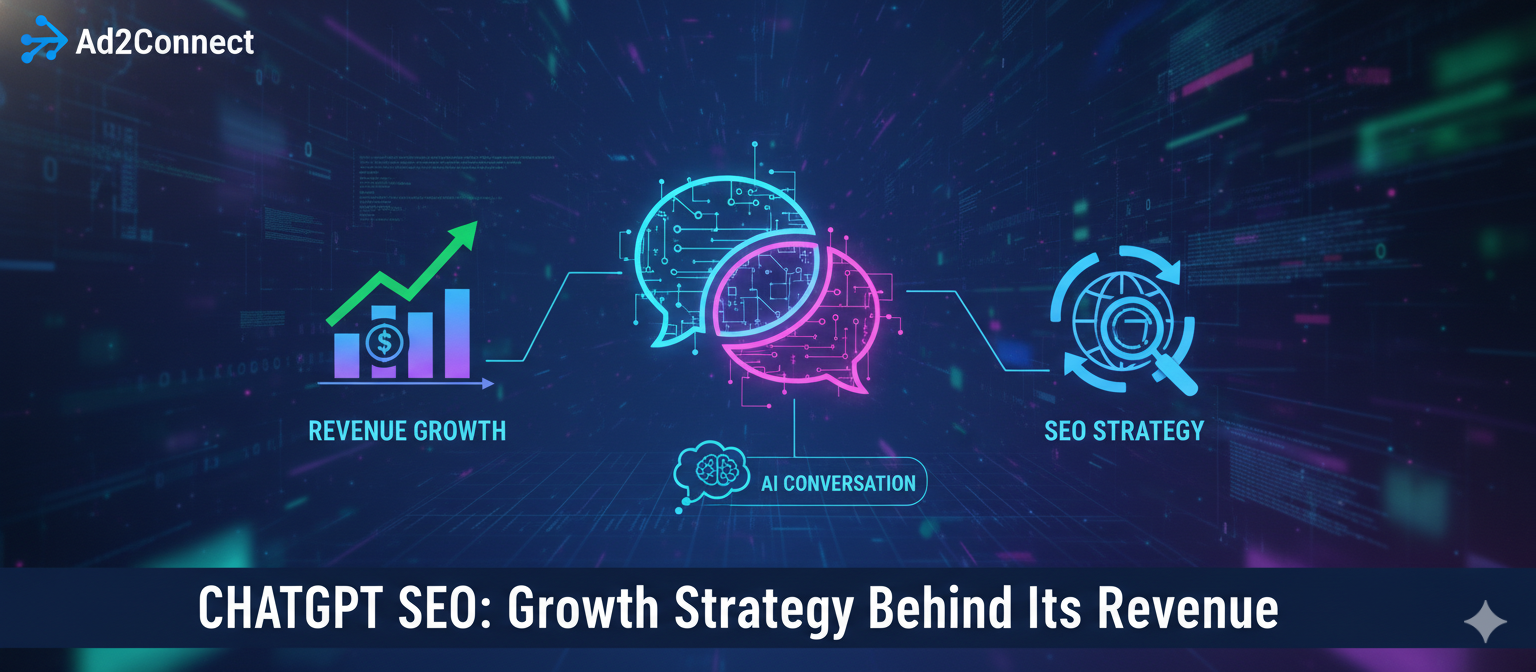
ChatGPT SEO: Growth Strategy Behind Its Revenue
Most companies treat SEO as a traffic channel. ChatGPT treats it as a growth engine. By aligning search intent with product education, ChatGPT turns organic visibility into user trust—and trust into revenue. This is not accidental. It is the result of semantic SEO, UX optimization, and content designed for both humans and AI systems.
In this guide, you will learn how ChatGPT uses SEO to drive growth and revenue, why the strategy works in modern search, and how your business can replicate it using ethical, Helpful Content–aligned methods.
Why SEO Is Central to ChatGPT’s Growth Model
ChatGPT benefits from search demand that already exists. Users do not search for “AI product features.” They search for answers such as:
- What is ChatGPT?
- How to use ChatGPT for SEO
- Best AI tool for content writing
Each query signals a learning need. ChatGPT’s SEO model ensures that when users arrive, they do not just get a definition. They see practical use cases that demonstrate value immediately.
This creates a growth loop: search discovery, helpful explanation, product trial, habit formation, and paid upgrade. That loop is what makes SEO revenue-driving instead of brand-only.
Search intent mapping includes top-of-funnel queries such as “What is ChatGPT?”, middle-of-funnel queries like “How to use ChatGPT for marketing?”, and bottom-of-funnel queries such as “ChatGPT vs other AI tools.” This content primarily targets informational and consideration-stage users researching AI-driven growth strategies.
Semantic SEO and Entity Authority
ChatGPT’s discoverability depends on entity relevance rather than keyword repetition. Search engines like Google evaluate topical authority across entire subject areas instead of individual pages.
Rather than ranking for one keyword, ChatGPT dominates related topics such as AI chatbots, generative AI, prompt engineering, SEO automation, and productivity tools. This builds entity trust across multiple contexts.
Semantic SEO is applied through natural language phrasing instead of robotic keywords, topic clusters built around real user questions, related concepts connected through internal links, and structured headings that match conversational queries.
This approach supports AI Overview and SGE visibility by making content easier to summarize and easier for AI systems to retrieve.
UX, Behavioral SEO, and Conversion Optimization
Search rankings do not exist in isolation. Behavioral signals such as how users interact with content reinforce authority and perceived usefulness.
ChatGPT benefits from long dwell time, repeat visits, brand searches, and high engagement. These are indirect ranking reinforcers tied to perceived quality.
From a CRO perspective, ChatGPT removes friction by offering minimal onboarding, a clear value proposition, example prompts, and fast time-to-first-result. Micro-conversions include trying a sample prompt, asking a second question, and exploring a new use case. Each action builds product trust, which increases lifetime value.
This combination of behavioral SEO and product-led growth allows SEO traffic to convert naturally into recurring users.
AIO, VEO, TEO, CIO, and MEO Explained
ChatGPT’s SEO success aligns with modern optimization frameworks used in AI-driven discovery.
AIO (AI Optimization): Content is structured so AI systems can summarize it easily. Clear headings, short paragraphs, and definitional sections improve eligibility for AI Overview results.
VEO (Voice Engine Optimization): Question-style headings mirror voice queries such as “How does ChatGPT use SEO?” and “What can ChatGPT do for marketers?”
TEO (Topic Experience Optimization): Users move from beginner content to advanced use cases without leaving the ecosystem, increasing topical depth and engagement.
CIO (Customer Intent Optimization): Keywords are mapped to real user jobs such as writing, coding, and research instead of vague marketing terms.
MEO (Multimodal Experience Optimization): Text is supported by diagrams, examples, and visual explanations, making the experience easier to understand across devices.
SEO as a Revenue Funnel
ChatGPT’s monetization does not rely primarily on ads. It relies on education. SEO-driven revenue happens when content answers real problems, users experience value, and paid plans unlock deeper usage.
Key metrics tied to revenue include organic click-through rate, time on page, branded query growth, feature page visits, and trial-to-paid conversion rate. When SEO content demonstrates features instead of describing them abstractly, users convert naturally.
This is why SEO is not separate from the product. It is part of product marketing itself.
GEO and Market Relevance
SEO growth varies by region. In markets such as the United States, the United Kingdom, and the European Union, ChatGPT benefits from high AI literacy, strong search demand for productivity tools, and enterprise adoption of generative AI.
For SaaS companies targeting localized markets, this strategy adapts through regional examples, local keyword modifiers, and country-specific regulations and use cases. Geographic optimization ensures the same topic feels relevant in different markets without duplicating content.
Practical Strategies You Can Apply
To replicate ChatGPT’s SEO growth model, businesses can follow several actionable steps. Build topic clusters instead of random blogs. Optimize content for AI summaries and voice search. Connect product features to real user questions. Use internal links to guide learning journeys. Design pages for skimming and accessibility. Treat UX as part of SEO rather than a separate discipline. Track engagement metrics instead of focusing only on rankings.
Accessibility and UX Enhancements
WCAG-friendly structure includes a clear heading hierarchy, short paragraphs, descriptive link text, and logical reading order. Images should be placed after the revenue funnel section, the semantic SEO explanation, and the optimization framework section.
Suggested captions include “How SEO transforms product discovery into revenue” and “Semantic topic authority model for AI platforms.”
Suggested alt text includes “SEO-driven growth funnel for AI platforms” and “Semantic SEO topic cluster for ChatGPT use cases.”
Conclusion
ChatGPT proves that SEO can be more than rankings. It can function as a revenue system. By combining semantic SEO, UX design, intent-based content, and AI-first structure, ChatGPT turns search visibility into user growth and growth into monetization.