
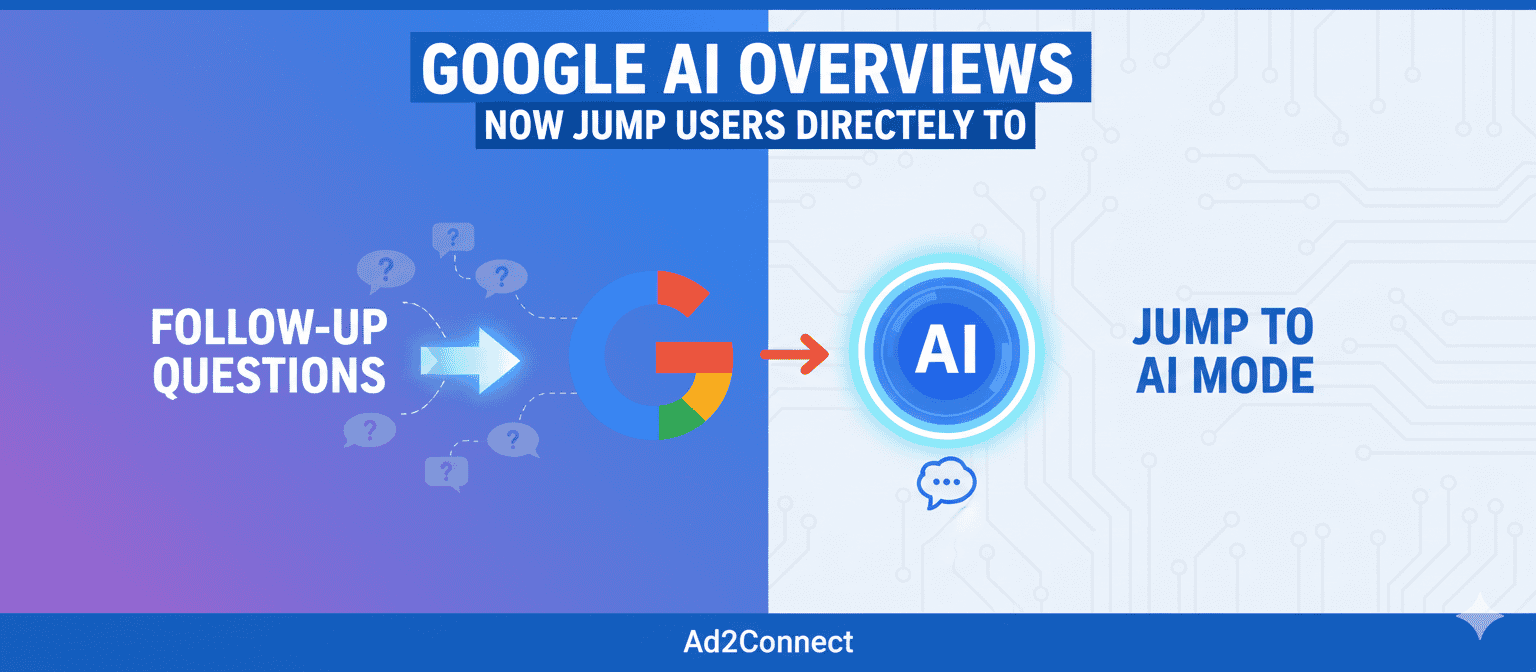
Google AI Overviews Follow-Up Questions Now Jump Users Directly to AI Mode
Google’s search experience is evolving rapidly, and the latest change around Google AI Overviews follow-up questions marks a major step toward conversational, AI-driven discovery.
When users now click on follow-up questions inside an AI Overview, Google sends them directly into AI Mode instead of showing traditional search results. This fundamentally changes how people explore information and how websites earn visibility.
For publishers, SEO professionals, and brands—especially those targeting informational search intent—this update signals a shift from traffic-first strategies to visibility-first and authority-driven strategies.
What Are Google AI Overviews?
Google AI Overviews are AI-generated summaries that appear at the top of certain search results. They aim to give users fast, contextual answers by synthesizing information from multiple web sources.
- Concise explanations
- Citations from trusted websites
- Bullet-style responses
- Follow-up questions for deeper exploration
AI Overviews are part of Google’s long-term transition toward conversational and multimodal search.
What Changed With Follow-Up Questions?
Previously, clicking a follow-up question below an AI Overview redirected users to a traditional search results page. Now, those clicks open AI Mode, a more immersive AI-powered interface.
- Users remain inside Google’s AI environment
- Traditional organic listings become secondary
- Information journeys become layered and conversational
This change increases engagement within Google while reducing external click-through opportunities for purely informational queries.
Why This Update Matters for SEO
Decline in Informational Clicks
Websites relying heavily on top-of-funnel content may see reduced CTR because users find answers inside AI Mode instead of visiting websites.
Increased Importance of AI Visibility (AIO)
SEO success now depends on being cited, being trusted, and being structured for AI consumption.
Shift Toward Entity-Based Discovery
Google increasingly maps content to entities rather than keywords. Brands recognized as authoritative entities are more likely to appear in AI-generated answers.
Practical SEO Strategies for AI Mode
Write for Questions, Not Just Keywords
Structure content around conversational queries such as:
- What is…
- How does…
- Is it worth…
- What are the risks of…
Strengthen Entity Signals (TEO + LEO)
Mention and contextualize brand names, industry terms, locations, and platforms. If operating in India or regional markets, include geographic and regulatory context to improve local entity optimization.
Optimize for Visibility, Not Just Traffic (VEO)
Track brand mentions, AI citations, impression share, assisted conversions, and branded search growth rather than relying solely on organic traffic.
Use Structured Content Formats
Use short paragraphs, clear subheadings, bullet lists, and definitions to improve AI parsing, mobile UX, and snippet eligibility.
Integrate CRO and SMO
Optimize landing pages for conversion efficiency and repurpose content into social-friendly summaries to maintain reach even with fewer organic clicks.
Content Intelligence and Measurement
With AI Mode expanding, marketers must use Content Intelligence Optimization (CIO) to analyze:
- Which pages are cited
- Which entities appear most often
- Which topics trigger AI Overviews
- Which content drives branded search
This insight refines topic clusters, internal linking, and update strategies.
Conclusion
The update to Google AI Overviews follow-up questions pushing users directly into AI Mode represents a turning point in search behavior.
Search is no longer only about rankings and clicks—it is about being cited, trusted, understood by AI, and useful across discovery journeys.
Brands that adapt using AIO, TEO, VEO, CRO, SMO, CIO, and MEO will gain a competitive advantage in AI-driven search.