
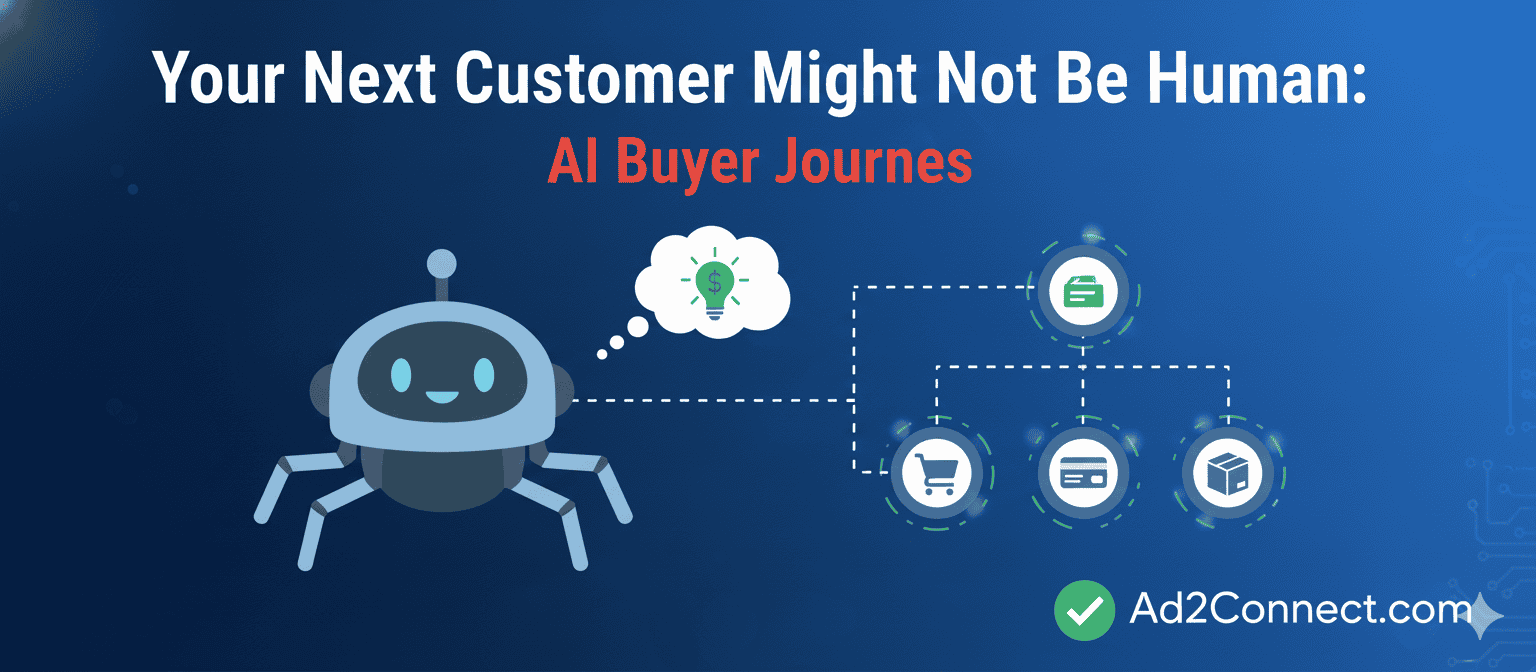
Your Next Customer Might Not Be Human: AI Buyer Journeys
What if your most important website visitor never sees your design, reads your copy emotionally, or clicks your call-to-action—yet still
decides whether your brand gets chosen?
AI agents are increasingly acting as intermediaries between businesses and buyers. From AI-powered search assistants and autonomous procurement tools to recommendation engines inside enterprise platforms, machines now research, filter, compare, and recommend brands before a human ever arrives.
This shift means customer journeys must be designed for both people and AI agents.
Brands that fail to adapt risk being filtered out early—not because they lack quality, but because machines cannot clearly understand or trust them.
Quick Insights
- AI agents now influence buying decisions before humans visit websites
- Machine-readable content improves brand discoverability
- Structured data and technical SEO improve AI trust signals
- Brands must optimize for both human UX and AI evaluation
Why AI Agents Are Now Part of the Buying Journey
AI agents do not browse the web like humans. They operate with clear objectives and evaluate information differently. Their goal is to
reduce effort and uncertainty for the user they represent.
- Search assistants summarizing the best solutions
- Procurement bots shortlisting vendors
- Voice assistants reordering products
- AI copilots recommending B2B software
Unlike humans, these systems prioritize clarity, structured information, authority signals, and factual accuracy rather than emotional storytelling.
How AI Buyer Journeys Differ From Human Journeys
Human buyers are influenced by design, emotion, social proof, and brand perception. AI agents evaluate content differently.
Machines prioritize efficiency, data clarity, and trust signals. That is why Content Indexing Optimization (CIO) and Technical SEO Optimization (TEO) are becoming just as important as branding.
If an AI agent cannot extract and validate your information easily, it may skip your brand entirely.
Why Traditional Funnels Alone Are No Longer Enough
Traditional marketing funnels assume a linear, human-driven path from awareness to conversion. AI-driven journeys operate very differently.
Machines evaluate multiple brands simultaneously, eliminate weaker options instantly, and recommend only the most reliable choices.
If your website lacks structured data, clear service definitions, or technical accessibility, your brand may never reach the consideration stage.
This is where All-In-One Optimization (AIO) becomes essential across content, technical performance, and authority signals.
Designing Customer Journeys for Humans and AI Agents
Build Machine-Readable Content Foundations (CIO)
AI systems rely on clarity and consistent structure to understand what your business offers.
- Use clear H1–H3 heading structures
- Add FAQ, Organization, and Service schema
- Maintain consistent brand descriptions
- Include concise summaries on key pages
Strengthen Technical and Mobile Readiness (TEO + MEO)
AI agents prefer technically reliable websites that load quickly and work well on mobile devices.
- Fast page speeds and strong Core Web Vitals
- Mobile-first layouts
- Clean internal linking structure
- Crawlable navigation
- Minimal reliance on JavaScript for critical content
Mobile SEO Optimization (MEO) is especially important because AI discovery closely follows mobile-first indexing.
Balance Visual Engagement With AI Clarity (VEO)
Visual content helps humans understand information, but AI systems still require textual explanations.
- Write descriptive alt text for images
- Explain charts and graphics in nearby text
- Add transcripts or summaries for videos
This approach strengthens Visual Engagement Optimization (VEO) while maintaining accessibility and AI readability.
Design Conversion Paths for Humans and Machines (CRO)
Conversion Rate Optimization now serves two audiences.
- Humans respond to CTAs, testimonials, and case studies
- AI agents analyze pricing clarity, services, and credibility signals
Optimizing for both improves overall conversion performance.
Build Authority Beyond Your Website (SMO + LEO)
AI agents evaluate trust signals across the entire web, not just your website.
- Consistent branding across social platforms (SMO)
- Strong geographic relevance for India and Mumbai (LEO)
- Mentions from authoritative publications
- Consistent business data across directories
Interactive Self-Assessment: Is Your Brand AI-Ready?
Ask yourself the following questions:
- Can an AI summarize my services in one sentence?
- Are my pages structured for easy indexing?
- Do my location signals clearly show where I operate?
- Would an AI trust my website as a reliable source?
If any answer is unclear, your customer journey design may require improvement.
Accessibility and UX Best Practices
Designing for accessibility improves usability for both humans and AI systems.
- Readable font sizes and generous spacing
- High color contrast
- Mobile-friendly layouts
- Clear and simple language
- Keyboard and touch accessibility