
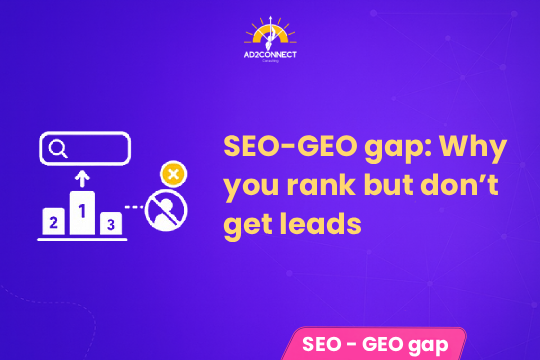
SEO-GEO Gap: Why You Rank But Don’t Get Leads
Your website is ranking… but your phone isn’t ringing.
That’s the reality for many business owners in Mumbai today. You’ve invested in SEO, hired a digital marketing agency in Mumbai, and even reached page one—but leads are still inconsistent or dropping.
The real problem isn’t your rankings.
It’s that search behavior has changed faster than your strategy.
What you actually want is simple:
- More qualified leads
- Lower cost per lead
- Predictable ROI from your marketing
This blog will show you exactly why you’re not getting leads—and how to fix it.
What Is the SEO-GEO Gap?
The SEO-GEO gap is the difference between ranking on search engines (SEO) and being visible in AI-generated answers (GEO).
- SEO focuses on website rankings and clicks
- GEO focuses on AI visibility and answers
- This reduces traffic but increases competition
To generate leads today, businesses must optimize for both.
Summary
- Ranking does not guarantee leads anymore
- AI answers reduce clicks to websites
- Intent matters more than traffic volume
- Local SEO is critical for Mumbai businesses
- SEO + performance marketing = better ROI
Understanding the SEO-GEO Gap
The SEO-GEO gap exists because search engines now give answers instead of just links.
Earlier:
User ? Search ? Click ? Website ? Convert
Now:
User ? Search ? AI Answer ? (Maybe Click) ? Convert
This “maybe click” is where most businesses lose leads.
Why You Rank But Still Don’t Get Leads
1. AI Is Replacing Clicks
Google now provides direct answers, reducing the need to visit websites.
2. Wrong Traffic
Ranking for high-volume keywords doesn’t mean high conversions.
3. Poor Conversion Setup
Even when users visit, weak landing pages and no clear CTA reduce leads.
4. Weak Local Presence
Without strong local SEO, competitors offering Local SEO Services in Mumbai will outrank you in visibility and trust.
Common Mistakes Businesses Make
- Focusing only on rankings
- Publishing generic content
- Ignoring AI-friendly structure
- Not investing in branding
- Treating SEO as a one-time task
How to Fix the SEO-GEO Gap
Step 1: Focus on Intent
Target keywords with buying intent, not just traffic.
Step 2: Optimize for AI
- Use clear answers
- Add bullet points
- Include FAQs
Step 3: Build Authority
Create topic clusters and consistent content in your niche.
Step 4: Strengthen Local SEO
Use Google Business Profile, reviews, and location pages.
Step 5: Combine SEO + Paid Ads
A performance marketing agency in Mumbai approach helps generate faster ROI.
Case Study
Client: Home renovation company
Before:
- Traffic: 22,000
- Leads: 55
- Cost per lead: ?2,400
After 5 Months:
- Traffic: 15,000
- Leads: 165
- Cost per lead: ?820
- ROI increased by 2.8X
Insight: Less traffic, more revenue.
Expert Insights
- Traffic is a vanity metric
- AI prefers simple, structured content
- Branding improves SEO performance
- Conversions matter more than rankings
Actionable Checklist
- Rewrite pages with direct answers
- Add FAQs to service pages
- Target high-intent keywords
- Build topic clusters
- Optimize for Mumbai-based SEO
- Improve website speed
- Track leads, not traffic
- Run paid campaigns alongside SEO
Conclusion
The SEO-GEO gap is not a trend—it’s the future of search.
Ranking is no longer enough.
You need to be the answer.
Businesses that adapt will generate more leads with less traffic.