
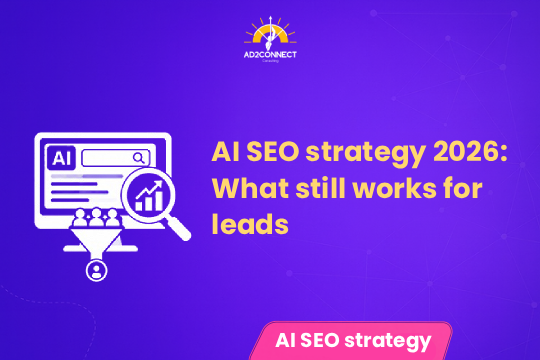
AI SEO Strategy 2026: What Still Works for Leads
SEO used to be simple: rank higher, get traffic, generate leads.
That formula is breaking.
Today, many Mumbai-based businesses are investing in SEO but seeing declining traffic, fewer leads, and unpredictable ROI. AI-generated answers are replacing search results, and traditional strategies are no longer enough.
What you really want is not rankings — you want consistent leads, lower cost per acquisition, and a system that scales.
This guide shows you exactly what still works in AI SEO in 2026 — based on real campaign results.
Does AI SEO Still Work?
Yes, AI SEO still works in 2026 — but only if you adapt your strategy.
- Focus on topical authority instead of isolated keywords
- Structure content for AI-generated answers
- Build trust using real data and case studies
- Combine SEO with performance marketing
SEO today is not about traffic — it’s about qualified visibility that converts into leads.
Summary
- AI SEO is evolving, not dying
- Rankings alone don’t drive leads anymore
- Content must be structured and authoritative
- Local SEO is critical for Mumbai businesses
- SEO works best with performance marketing
- Quality beats quantity in content
Why Most SEO Campaigns Fail Today
The biggest problem isn’t AI — it’s outdated strategy.
Most businesses still rely on:
- Generic blog content
- Keyword stuffing
- Vanity metrics like traffic
But AI search engines now summarize answers directly and prioritize credible, structured content.
So even if you rank, you may not get leads.
Common Mistakes That Kill Your SEO ROI
1. Creating Content Without Intent
Writing blogs without solving real customer problems leads to low conversions.
2. Ignoring Local SEO
If you’re targeting Mumbai customers, local SEO matters more than global rankings.
3. Chasing Traffic Instead of Leads
High traffic without conversions wastes budget.
4. Not Integrating SEO with Paid Ads
SEO alone is slow. Combining it with performance marketing accelerates results.
What Actually Works in AI SEO
1. Build Topic Clusters
Create content around a single theme instead of random blogs. This builds authority that AI prefers.
2. Structure Content for AI
- Direct answers in first 50 words
- Bullet points
- Clear headings
- Data-backed insights
3. Focus on Conversions
Optimize for leads, calls, and enquiries — not just traffic.
4. Strengthen Local SEO
Optimize Google Business Profile, target local keywords, and build reviews.
5. Combine SEO with Performance Marketing
SEO builds long-term growth, while paid ads generate immediate leads.
Case Study
A service-based business in Malad approached us after poor results.
Before:
- Leads/month: 15
- Cost per lead: ?4,200
- ROI: Low
Strategy:
- AI SEO content clusters
- Local SEO optimization
- Paid campaign integration
- Conversion-focused landing pages
After 4 Months:
- Leads/month: 72
- Cost per lead: ?1,380
- Conversion rate: 2.8X increase
Result: 4X more leads and 60% lower acquisition cost.
Expert Insights
- Traffic is becoming a vanity metric
- Authority beats keyword optimization
- Less content, better quality wins
- SEO without conversion strategy fails
Actionable Checklist
- Identify top 5 customer pain points
- Create content solving those problems
- Add real examples and data
- Optimize for Mumbai keywords
- Improve Google Business profile
- Combine SEO with paid ads
- Track leads, not just traffic
- Remove low-quality content
Conclusion
AI hasn’t replaced SEO — it has made it smarter.
The businesses that will win in 2026 are those that:
- Focus on real customer problems
- Build authority and trust
- Align SEO with business outcomes
If you adapt, SEO becomes your most profitable channel. If you don’t, it becomes an expense.