
Google AI Overviews Accuracy: 90% Correct but Millions of Errors Still Exist
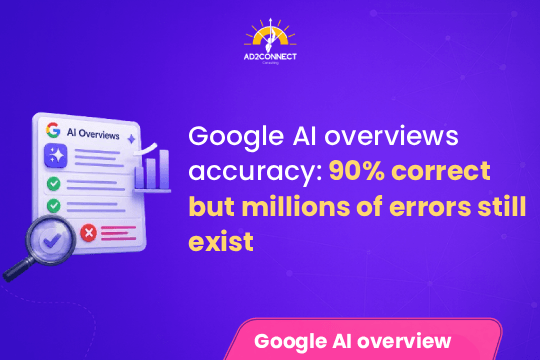
Google AI Overviews, powered by Google’s Search Generative Experience (SGE) and large language models (LLMs), aim to deliver fast, summarized answers directly in search results. While studies suggest an accuracy rate of around 90%, the remaining 10% creates millions of incorrect responses at scale.
These inaccuracies are often caused by outdated sources, conflicting data, or AI misinterpretation. As a result, users may receive incomplete or misleading information, especially for complex or sensitive queries.
Google AI Overviews are reshaping the search experience by replacing traditional blue links with AI-generated summaries. Built within Google’s evolving AI search ecosystem, this feature is designed to improve efficiency and reduce the time users spend browsing multiple pages.
However, with this shift comes a major question: how accurate is Google AI search?
Industry analysis and real-world testing indicate that while Google AI Overviews achieve around 90% accuracy, they still produce a significant number of incorrect answers. This creates a paradox—faster access to information but increased risk of misinformation.
Key Insight: Accuracy alone is not enough—context, depth, and trustworthiness define quality in AI search.
What Are Google AI Overviews?
Google AI Overviews are AI-generated summaries displayed at the top of search results. They combine information from multiple sources using LLM-based AI systems to provide quick answers.
Key Characteristics
- Appear above organic search results
- Summarize multiple sources into one answer
- Provide conversational responses
- Reduce the need for multiple clicks
Key Insight: Search is evolving from “information discovery” to “instant answer delivery.”
How Accurate Is Google AI Search?
The accuracy of Google AI Overviews is estimated at approximately 90%, but this varies significantly depending on the type of query.
Accuracy by Query Type
- High Accuracy: Definitions, general knowledge
- Moderate Accuracy: Tutorials, comparisons
- Low Accuracy: Health, finance, legal topics
Key Insight: AI performs best with structured, factual queries but struggles with nuance and context.
Real Experience & Micro Observations
Based on SEO testing and real query analysis, several patterns emerge in AI-generated search results:
- High reliability for simple, direct queries
- Increased errors in long-tail or multi-intent searches
- Frequent inconsistencies in rapidly changing topics
Micro Observations
- AI often merges data from multiple sources incorrectly
- Product comparisons may include outdated or mismatched features
- Important details are sometimes omitted for brevity
Key Insight: AI prioritizes summarization over completeness, which can lead to misleading outputs.
Why Google AI Overviews Errors Occur
1. Dependence on Web Content
AI relies on existing content, which may be outdated, biased, or inaccurate.
2. Context Misinterpretation
Complex queries with multiple meanings often confuse AI systems.
3. AI Hallucinations
LLMs may generate plausible but incorrect information.
4. Conflicting Sources
When sources disagree, AI may produce inconsistent summaries.
Key Insight: These challenges are commonly known as Google SGE accuracy issues.
Types of AI-Generated Search Problems
- Factual inaccuracies
- Incomplete information
- Misleading summaries
- Outdated data
- Risk-sensitive misinformation
Key Insight: Errors are more dangerous in high-stakes topics like finance and healthcare.
AI Search vs Traditional Search
Traditional Search
- Multiple sources for comparison
- Higher transparency
- User-driven verification
AI Search
- Single summarized answer
- Faster results
- Reduced transparency
Key Insight: AI search improves speed but reduces user control.
Impact of AI Overviews on SEO
The impact of AI Overviews on SEO is reshaping digital marketing strategies.
- Decline in organic traffic
- Rise of zero-click searches
- Increased importance of authority
Key Insight: Ranking is no longer enough—being referenced by AI is the new goal.
SEO Action Framework (Step-by-Step)
- Audit Your Content
- Remove thin or duplicate pages
- Focus on User Intent
- Target informational and comparison queries
- Use Entity-Based SEO
- Google SGE
- LLM-based AI systems
- AI search ecosystem
- Add Real Experience
- Include examples, insights, and testing results
- Strengthen Trust Signals
- Ensure factual accuracy
- Use updated data
Key Insight: Google rewards content that demonstrates real expertise and experience.
Trust & Data Attribution Layer
One of the most important updates in Google’s algorithm is the focus on trust and content credibility.
How to Build Trust
- Use verified and recent data
- Provide balanced viewpoints
- Avoid exaggerated claims
Key Insight: Trust is becoming a ranking factor in AI-generated search visibility.
Future of SEO with AI Overviews
The future of SEO with AI Overviews will be shaped by:
- Topical authority
- Semantic SEO
- Experience-driven content
Key Insight: SEO is evolving from keyword optimization to entity and intent optimization.
Practical Tips / Best Practices
- Improve content depth (not just keywords)
- Add real experience, examples, and data
- Remove thin or duplicate pages
- Strengthen internal linking structure
- Focus on topical authority
- Improve UX and engagement
Common Mistakes to Avoid
- Publishing generic AI-generated content
- Ignoring fact-checking
- Over-optimizing keywords
- Misunderstanding user intent
Conclusion
Google AI Overviews represent a major shift in how search works, offering fast and convenient answers powered by advanced AI systems. While their accuracy is around 90%, the remaining margin leads to millions of incorrect outputs.
Final Key Insight: In the AI search era, success depends not just on ranking—but on being trusted, cited, and contextually relevant.
Businesses and SEO professionals must adapt by focusing on quality, authority, and real value. Those who embrace this shift early will gain a competitive advantage in the evolving AI-driven search landscape.