
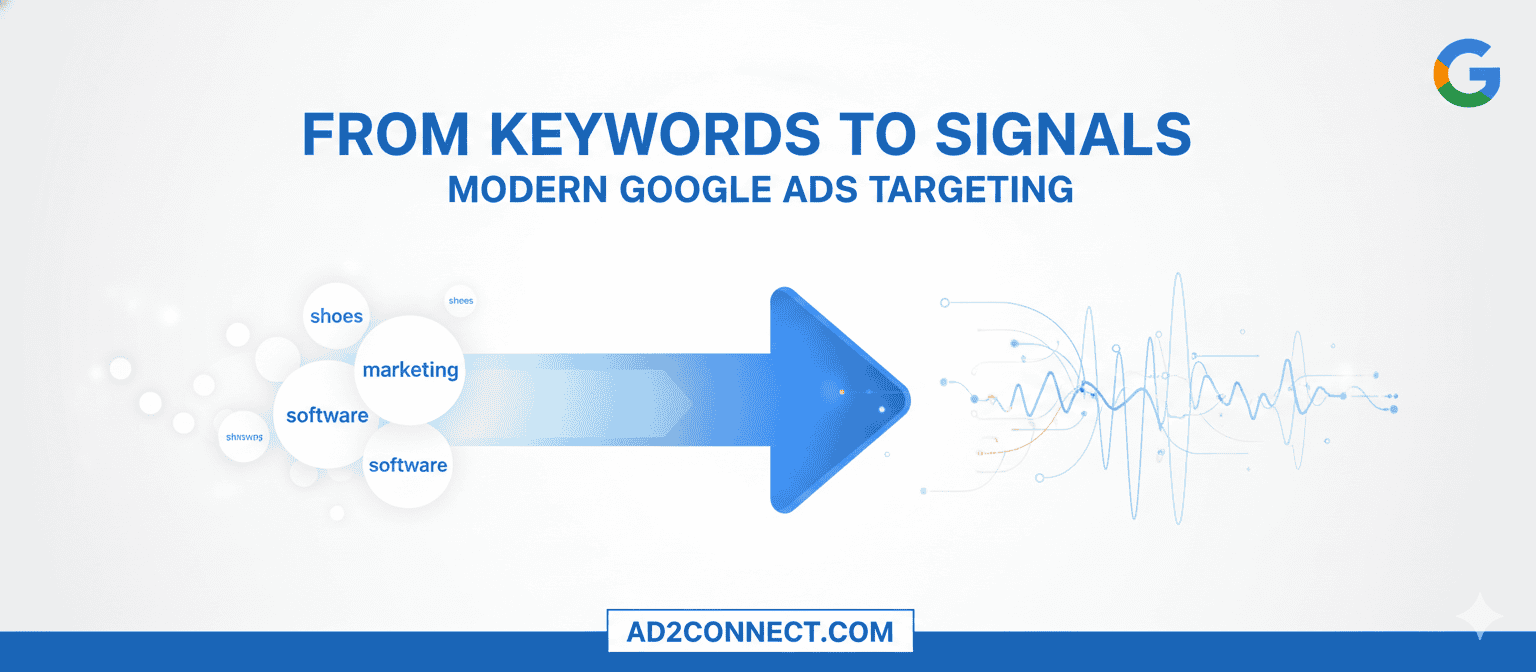
From Keywords to Signals: How Pros Build a Modern Google Ads Targeting Strategy
They focus on signals, intent, and data quality. Google’s AI does the heavy lifting
when it’s trained the right way.This guide explains how to build a modern Google Ads targeting strategy like a pro,
especially for competitive markets like Mumbai.
What Has Really Changed in Google Ads Targeting?
Short answer: Targeting is no longer rule-based. It’s prediction-based.
Google Ads now evaluates thousands of real-time signals to decide who sees your ad and when.
Your role is to provide better inputs—not restrict reach.
- Keywords now act as signals, not strict filters
- Audiences guide AI instead of limiting reach
- Automation is now the default
In high-density cities like Mumbai, these changes allow advertisers to capture intent more
efficiently across devices and moments.
The Four Pillars of a Pro-Level Targeting Strategy
1. Intent-Led Keyword Structure
Professionals don’t chase keywords. They chase user intent.
Broad match keywords combined with smart bidding help Google understand patterns instead of
isolated searches.
2. First-Party Data Fuels Performance
Google Ads runs on data. The stronger your first-party signals, the better the system performs.
- GA4 conversion events
- Enhanced conversions
- CRM and offline data uploads
3. Audience Signals, Not Audience Cages
Modern targeting uses audiences as hints, not restrictions.
- In-market audiences
- Custom search intent segments
- Website visitors and Customer Match
For Mumbai advertisers, combining local intent with device and time-based signals improves
lead quality without limiting scale.
4. Creatives Act as Targeting Signals
Your ad copy influences who your ads reach. Google matches creatives to users most likely
to engage.
Use multiple responsive search ad headlines, strong value propositions, and local cues
where relevant.
How Google’s AI Uses Your Targeting Inputs
Smart Bidding in Real Time
Smart bidding evaluates location, device, time, behavior, and conversion probability
within milliseconds.
Performance Max and Modern Targeting
Performance Max campaigns rely on audience signals and conversion data to expand reach
across Search, YouTube, Display, Discover, and Gmail.
Common Targeting Mistakes to Avoid
- Over-controlling audiences instead of guiding AI
- Optimizing for volume instead of qualified conversions
- Ignoring local intent differences across cities
- Poor tracking and data gaps
Best Practices for Modern Google Ads Targeting in 2025
- Use broad match with smart bidding
- Feed Google consistent first-party data
- Optimize for intent, not just keywords
- Refresh creatives regularly
Conclusion — Smarter Signals Drive Better Results
Modern Google Ads targeting is about collaborating with AI, not fighting it.
When intent-based keywords, strong data, audience signals, and high-quality creatives work
together, campaigns scale efficiently and sustainably.
Train the system well—and let it do what humans can’t.