
Year-End PPC Report Framework: A 5-Step Guide That Resonates With Leadership
Who This Guide Is For
This guide is designed for PPC managers, marketing leaders, CMOs, founders, and agency teams who need to present paid media performance to executives and stakeholders in a way that supports confident budget decisions.
Why Leadership Needs a Better Year-End PPC Report
A year-end PPC report is more than a performance recap—it is a decision-making tool.
Yet many PPC reports fail because they focus on platform-level metrics rather than business outcomes. Leadership teams do not want to decode impressions, click-through rates, or keyword lists. They want to understand impact, efficiency, and future opportunity.
This article introduces a proven year-end PPC report framework that translates paid media data into leadership-ready insights aligned with growth, profitability, and strategic planning.
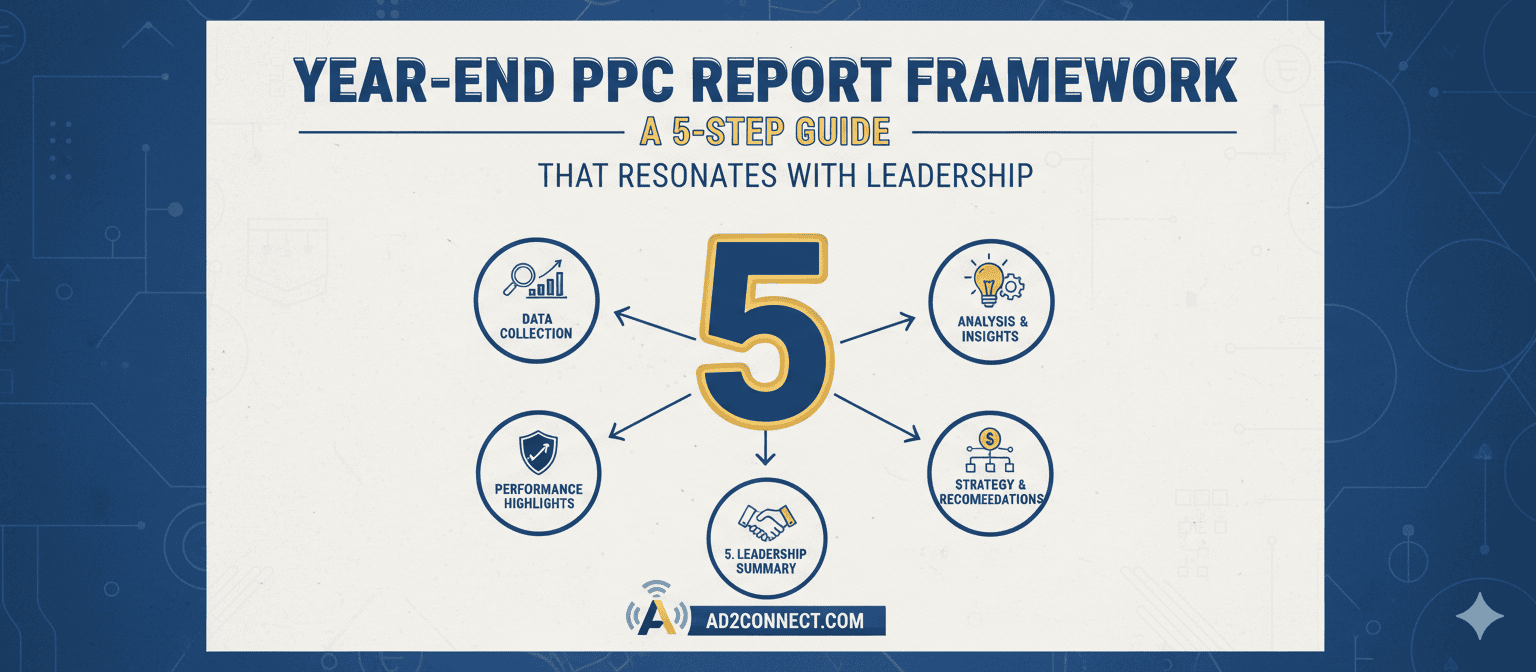
Step 1: Anchor the Report to Business Objectives
The most effective year-end PPC reports start with business goals, not metrics.
Before presenting performance data, clearly explain:
- The primary business objective PPC supported
- How paid media aligned with company-wide goals
- Key constraints or opportunities that shaped results
For example, instead of opening with spend or impressions, frame results like this:
“PPC supported revenue growth while maintaining profitability during a highly competitive year with rising CPCs.”
This framing positions PPC as a growth lever rather than a cost center and immediately resonates with leadership.
Step 2: Focus on Revenue and Efficiency Outcomes
Leadership evaluates PPC performance through the lens of return on investment.
Rather than overwhelming stakeholders with every available metric, focus on outcomes that directly impact the business, such as:
- Revenue or pipeline influenced by PPC
- Return on ad spend (ROAS)
- Cost per acquisition (CPA)
- Conversion rate improvements driven by CRO
Explain why these outcomes matter:
“Despite increased competition, PPC efficiency improved due to stronger conversion rates and refined audience targeting.”
This outcome-driven approach aligns reporting with CRO, CIO, and leadership priorities.
Step 3: Explain the Story Behind the Performance
Metrics alone do not tell the full story. Leadership needs context.
Use your year-end PPC report to explain why performance changed, clearly separating internal actions from external influences.
Internal drivers may include:
- AI-led bidding and automation improvements (AIO)
- Creative testing and message refinement (VEO)
- Landing page and funnel optimization (CRO and LEO)
External factors may include:
- Market demand shifts
- Platform algorithm updates
- Seasonality and geographic performance trends (MEO)
This level of transparency builds trust and demonstrates strategic maturity.
Step 4: Translate Insights Into Forward-Looking Strategy
The most important question leadership asks after reviewing a PPC report is:
“What should we do next?”
Use your insights to clearly outline future actions, including:
- Which campaigns or channels should be scaled
- What should be optimized or paused
- New opportunities worth testing
Examples include expanding high-performing campaigns, entering new geographic markets, increasing CRO investment, or testing AI-driven bidding strategies with performance guardrails.
This step transforms your PPC report into a strategic planning asset.
Step 5: End With a Clear Executive Summary
Your executive summary is often the most-read section of the report.
It should deliver clarity in under two minutes by summarizing:
- Key performance wins
- Primary challenges or risks
- A clear recommendation for future investment
A strong executive summary supports faster decision-making and reinforces confidence in your PPC strategy.
Accessibility and UX Best Practices for PPC Reports
To align with WCAG standards and Google’s Helpful Content Guidelines, ensure your PPC reports are:
- Mobile-friendly and easy to scan
- Written in clear, non-technical language
- Designed with readable font sizes and sufficient contrast
- Structured with descriptive headings and logical flow
- Supported by meaningful visuals and descriptive alt text
Accessible reporting improves comprehension, engagement, and leadership trust.
Conclusion: Turn PPC Reporting Into Leadership Alignment
A strong year-end PPC report does more than summarize performance—it tells a story that builds confidence, justifies investment, and shapes future strategy.
By using this year-end PPC report framework, marketers can elevate paid media reporting from tactical updates to executive-level insights that drive action.