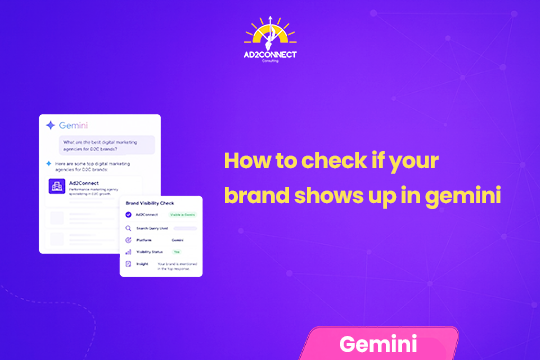
How to Check If Your Brand Shows Up in Gemini
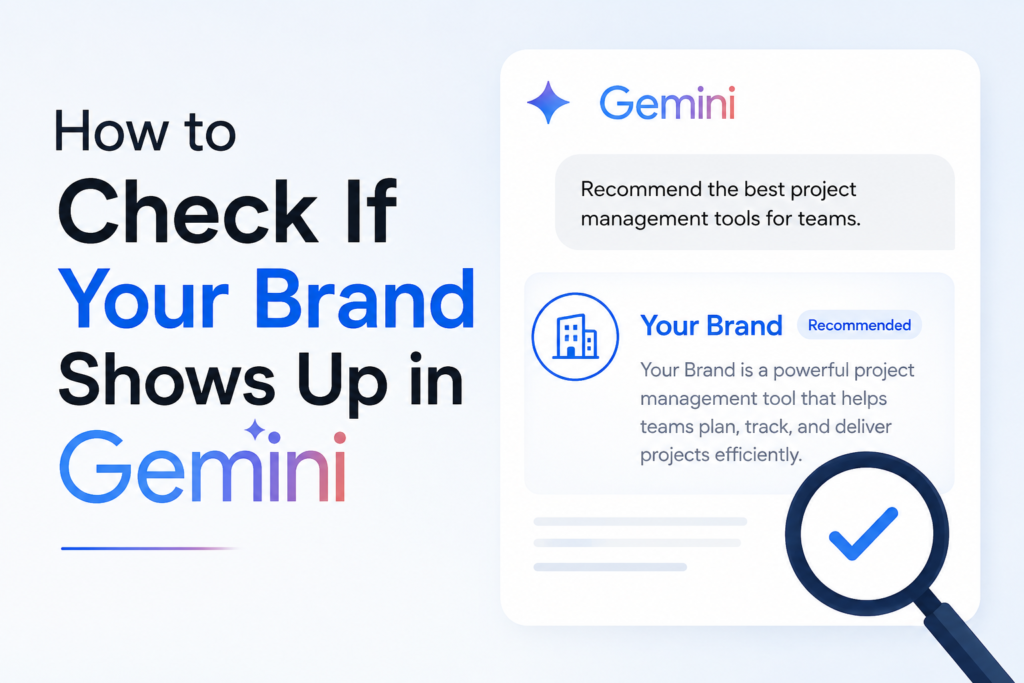
Someone could be learning about your brand from Gemini right now. Your website analytics would never know it happened. Here’s how to find out what’s actually going on, in plain language.
By Snehal Singh | Published: August 4, 2026
AI Overview Summary
Gemini is Google’s AI assistant. It’s the kind of tool people ask questions to instead of typing a search into Google. When Gemini mentions your brand in its answer, that moment doesn’t show up in your website analytics at all. Nobody clicked a link to get there. To check whether your brand shows up in Gemini, you need three things working together: checking real Gemini answers by hand, using tools that track this automatically, and watching your regular website data for hints that Gemini is quietly influencing visitors before they land on your site.
Table of Contents
- What Is Gemini, and Why Does It Matter for Your Brand?
- Why This Is So Hard to Track
- 3 Ways to Check If Your Brand Shows Up in Gemini
- Comparing the 3 Methods
- What This Data Is Really Telling You
- Mistakes That Look Like Strategy
- How Ad2Connect Approaches AI Visibility Tracking
- Key Takeaways
What Is Gemini, and Why Does It Matter for Your Brand?
Gemini is Google’s AI assistant. Instead of typing a short search term and clicking through a list of links, someone can ask Gemini a full question. They get a direct answer back.
That answer might mention specific brands, including yours. The person may never visit your website at all. They might just read the answer, form an opinion, and move on with their research somewhere else.
This matters because a lot of buying decisions start exactly this way now. Someone researching a product or service might ask Gemini for recommendations. This can happen long before they ever type your brand name into Google.
Why This Is So Hard to Track
Normal website tools, like Google Analytics, only see what happens after someone visits your site. They can’t see a Gemini conversation that never led to a click.
That’s already tricky. But there’s a second problem. Gemini doesn’t give the same answer to everyone.
Two people can ask the exact same question and get two different answers. Location, past searches, personal settings, and small changes in wording can all shift what Gemini says. They can also change which brands get mentioned, so there’s no single “ranking” to check the way there is with a normal Google search.
Instead of chasing one fixed number, the smarter approach is watching for patterns over time, since a single answer on a single day tells you very little on its own, but the same question asked consistently over weeks or months starts to reveal something real: whether your brand shows up often, whether it’s usually recommended or just mentioned in passing, and whether it’s positioned ahead of competitors or behind them.
3 Ways to Check If Your Brand Shows Up in Gemini
1. Check Real Gemini Answers by Hand
This means typing in the questions your customers might actually ask. Then read exactly what Gemini says back.
- Early research questions, like “what is [your product category]?”
- Comparison questions, like “[your brand] vs [a competitor].”
- Final decision questions, like “is [your brand] worth it?” or “[your brand] pricing.”
For each question, don’t just note whether your brand came up. Write down where it appeared in the answer. Note which competitors were mentioned alongside it. Check which sources Gemini pulled information from. Ask whether the description of your brand was actually accurate.
Repeat this regularly. Weekly works well for a competitive market. Monthly is often enough for most other businesses.
2. Use Automated AI Visibility Tools
Checking questions by hand works fine for a small list. It becomes unrealistic once you want to track hundreds of questions consistently.
- How often your brand gets mentioned across a large set of tracked questions.
- How your visibility compares to competitors.
- Which sources Gemini is citing when it mentions you.
- Whether your visibility is trending up or down over time.
One limitation is worth knowing upfront. These tools test a fixed set of questions under consistent conditions. They give you a reliable trend line, not a perfect recreation of every possible real conversation a customer might have.
3. Watch Your Website Analytics for Indirect Clues
Visibility tools tell you whether you’re showing up in Gemini. Your regular website analytics can help confirm whether that visibility is actually leading anywhere.
Some Gemini conversations do send visitors directly to a website. Check for referral traffic coming from Gemini, along with how those visitors behave once they land on a page.
Beyond that, watch broader trends too. Look for a rise in people searching your brand name directly. Watch for more visitors typing your website address straight into their browser. Track better performance on pages Gemini tends to cite as a source. None of these prove Gemini caused the change on its own. But when they line up with better performance in your manual checks and visibility tools, they add up to real evidence.
Comparing the 3 Methods
| Method | Best For | Main Limitation | How Often to Use It |
|---|---|---|---|
| Manual checks | Understanding context, wording, and accuracy | Doesn’t scale past a small list of questions | Weekly to monthly |
| AI visibility tools | Tracking hundreds of questions consistently | Tests fixed conditions, not every real conversation | Ongoing, automated |
| Website analytics | Confirming real business impact | Can’t prove Gemini caused a specific change on its own | Reviewed alongside the other two |
What This Data Is Really Telling You
For years, marketing measurement has mostly looked backward. Clicks, visits, and sales all tell you what already happened. They show what occurred after someone found your brand and acted on it.
Checking your Gemini visibility measures something earlier than that. It shows whether your brand was part of the conversation while someone was still deciding what to buy. There was never a click to measure in the first place.
That’s a meaningful shift. You don’t have to wait for traffic to tell you your marketing worked. You can start to see whether your brand earned a place in someone’s thinking from the start.
Mistakes That Look Like Strategy
- Checking Gemini once and assuming that single answer represents everyone’s experience.
- Relying only on automated tools and skipping manual checks that reveal how your brand is actually described.
- Giving up because there’s no single “Gemini ranking” number to track.
- Ignoring website analytics entirely, missing signs that Gemini visibility is already influencing real visitors.
- Treating one good or bad mention as a trend instead of watching for a pattern over time.
How Ad2Connect Approaches AI Visibility Tracking
At Ad2Connect, we treat AI visibility the same way we treat any other measurement problem. We combine multiple signals instead of relying on one number that doesn’t tell the whole story.
This mirrors the thinking behind our other guides on adapting to how search itself is changing. It connects to our post on keyword research vs prompt research, since both are about understanding real demand beyond a single Google Search number. It also builds on our take on AI and human expertise in SEO, since the same real expertise that helps content rank also helps a brand get mentioned accurately inside an AI answer. It’s part of a broader SEO strategy built around every place your customers are actually researching, not just the ones your analytics can already see.
If you have no idea whether your brand comes up in Gemini right now, that’s the first gap worth closing before anything else.
Key Takeaways
- Gemini mentions don’t show up in your normal website analytics, since many conversations never lead to a click.
- There’s no single “Gemini ranking.” Answers vary by person, so watch patterns over time instead of chasing one perfect result.
- Use three methods together: manual checks for context, automated tools for scale, and website analytics for real-world impact.
- This measures something earlier than clicks. It shows whether your brand was part of the conversation before a buying decision was made.
- Consistency matters more than any single check. Repeat the process regularly to spot real trends.