
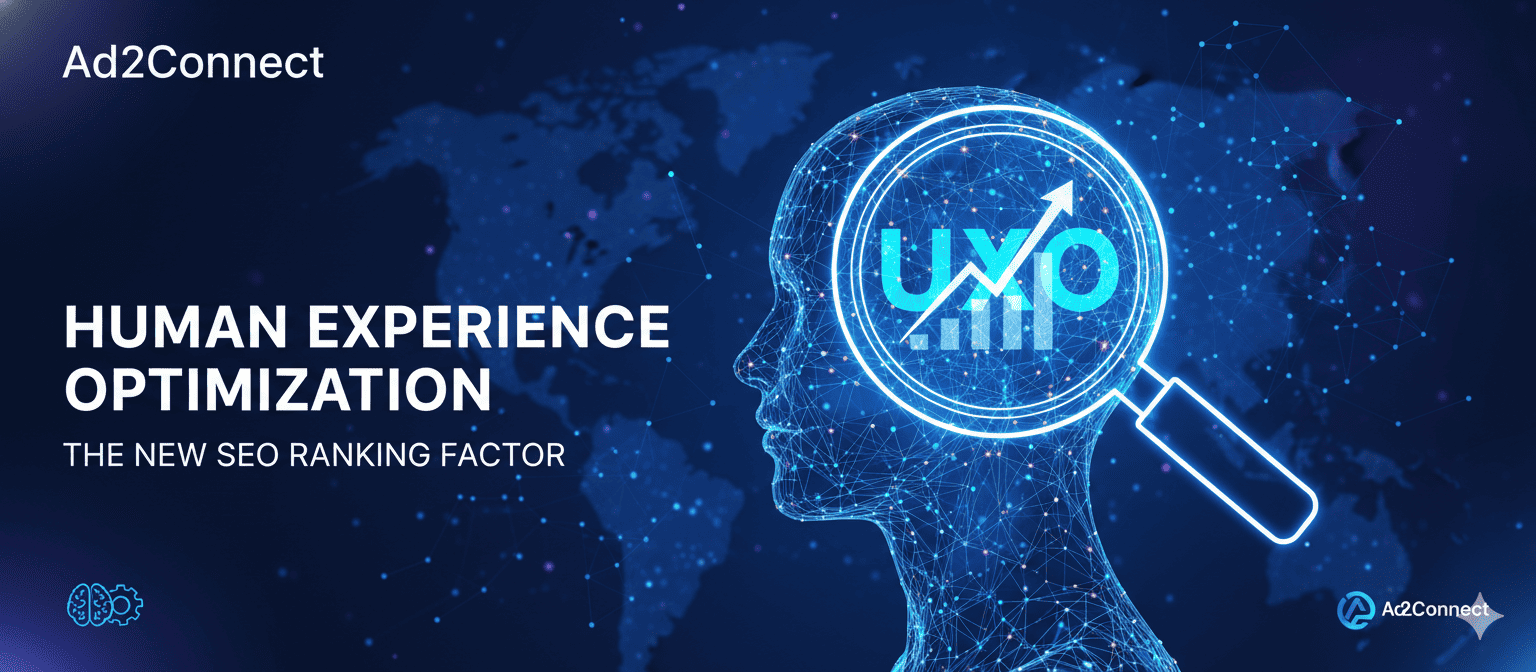
Human Experience Optimization: The New SEO Ranking Factor
Search engine optimization is no longer just about keywords and backlinks. Today, it is about how people feel when they use your website.
Google’s algorithms increasingly mirror human judgment. If users find your site confusing, slow, or untrustworthy, your rankings suffer. If users stay longer, scroll deeper, and complete actions, your visibility improves. This evolution has given rise to Human Experience Optimization (HXO) — a strategy focused on aligning technical SEO, usability, emotional design, and behavioral data into one unified approach.
For brands like Ad2Connect that focus on performance-driven digital marketing, HXO represents the next frontier of sustainable search growth. It connects SEO, CRO, UX, and AI optimization into a single experience-first model that satisfies both users and search engines.
What Is Human Experience Optimization?
Human Experience Optimization is the practice of improving digital experiences so that both humans and machines interpret them as valuable, trustworthy, and useful. It goes beyond traditional UX by incorporating:
- Search intent understanding
- Emotional design and trust signals
- Accessibility and inclusivity
- Conversion psychology
- AI readability and entity clarity
HXO is deeply aligned with Google’s Helpful Content System, E-E-A-T (Experience, Expertise, Authoritativeness, Trustworthiness), and Core Web Vitals. It also draws insights from the Chrome UX Report, which measures real user performance data at scale.
Instead of optimizing pages in isolation, HXO optimizes entire user journeys — from search result click to final conversion.
Why Experience Now Shapes Search Visibility
Modern ranking systems like RankBrain and Google’s machine learning models interpret how users interact with content. They analyze behavioral signals such as:
- Click-through rate
- Time on page
- Scrolling behavior
- Task completion
- Navigation patterns
- Mobile usability
- Page stability
When users find what they need quickly and easily, it sends a positive satisfaction signal. When users leave frustrated, it sends a negative one. This means search visibility is no longer driven only by relevance — it is driven by perceived usefulness.
In competitive markets like New York, London, Dubai, and Singapore, where businesses fight for attention in crowded search results, optimizing for experience becomes a major differentiator. Local brands that load faster, communicate clearer, and feel safer win both clicks and customers.
The Ad2Connect Human Experience Framework
Ad2Connect applies Human Experience Optimization using a proprietary approach built on five pillars:
Cognitive Clarity
Content is structured for easy scanning, logical flow, and instant comprehension. Headings guide meaning and layout reduces cognitive load.
Emotional Trust
Visual design, copy tone, and credibility signals reduce user anxiety and increase confidence. This includes reviews, authorship transparency, and security indicators.
Behavioral Alignment
User intent is matched with page purpose. Informational queries lead to educational experiences while transactional queries lead to conversion-focused design.
Technical Comfort
Pages load fast, remain stable, and adapt seamlessly across devices. Core Web Vitals are treated as comfort metrics, not just technical scores.
AI Interpretability
Content is structured so search engines and AI systems can extract meaning, entities, and answers accurately for AI Overviews and future search experiences.
Accessibility as a Ranking Multiplier
Accessibility is no longer optional. It directly improves engagement and reduces bounce rates.
- Clear heading hierarchy for screen readers
- Descriptive alt text for images
- Sufficient color contrast for text
- Keyboard navigable menus
- Logical focus order
- Readable font sizes on mobile
- Error messages that explain what went wrong
- Buttons with clear purpose labels
When accessibility improves, dwell time improves. When dwell time improves, search engines detect satisfaction. Accessibility is experience optimization for everyone.
Visual and Content Experience Optimization
Visual clarity shapes user perception within milliseconds. A cluttered interface creates distrust while a clean layout creates confidence.
Effective experience-driven design uses white space to guide attention, consistent typography, visual hierarchy, compressed images, and fast-loading media.
From a content perspective, HXO requires direct answers to questions, context-rich explanations, examples, clear summaries, strong internal linking, and natural semantic keyword usage. This makes content both human-friendly and AI-readable.
Interactive Element: HXO Self-Assessment
- Does my page answer the search query in the first 10 seconds?
- Can users navigate it easily on mobile?
- Is the primary call to action visible without scrolling?
- Does the design build trust immediately?
- Would I bookmark this page as a visitor?
- Does it feel written for humans instead of bots?
If you answered “no” to more than two, your experience may be costing you rankings.
GEO and Local Experience Optimization
For businesses targeting geographic audiences, Human Experience Optimization must include Local Experience Optimization.
This includes city-specific service pages, embedded maps, local testimonials, regional schema, and culturally relevant language. A digital agency serving Toronto users, for example, should address local pricing expectations, industry context, and compliance requirements. This improves trust and relevance simultaneously.
Conclusion
Search engines now measure what humans feel.
Human Experience Optimization is not a trend. It is the logical evolution of SEO. It reflects how Google’s Helpful Content System, E-E-A-T principles, and behavioral signals work together to reward clarity, usability, and trust.
By focusing on cognitive clarity, emotional trust, behavioral alignment, technical comfort, and AI interpretability, brands can future-proof their visibility. For Ad2Connect, this approach ensures marketing strategies do more than attract clicks — they create meaningful, satisfying experiences that convert and rank.