Keyword vs Prompt Research: A Smarter Way to Prioritize Content
Some topics barely show up in Google search, but people ask AI chatbots about them constantly. If you only look at one number, you’re missing half the picture. Here’s a simple way to see both.
By Snehal SIngh | Published: August 4, 2026
AI Overview Summary
Keyword research shows how often people type a topic into Google. Prompt research is a newer, similar idea, it shows how often people ask AI chat tools like ChatGPT, Gemini, or Perplexity about that same topic. These two numbers don’t always match. A topic can look small in Google but come up constantly in AI conversations, or the other way around. Comparing both numbers side by side helps a business decide what kind of content to create: a classic search-friendly page, a page built to be quoted by AI, or both for the topics that show strong demand everywhere.
Table of Contents
- What Is Keyword Research?
- What Is Prompt Research?
- Keyword Research vs Prompt Research, Side by Side
- Why One Number Alone Isn’t Enough
- The 3 Content Buckets This Creates
- A Quick Warning About Blank Results
- How to Try This Yourself
- Mistakes That Look Like Strategy
- How Ad2Connect Uses This Approach for Clients
- Key Takeaways
What Is Keyword Research?
Keyword research is the classic way marketers figure out what content to write. It answers a simple question: how many people type a certain phrase into Google every month?
If thousands of people search “best running shoes for flat feet,” that tells a business there’s real demand for content about that exact topic. Tools like Google’s own Keyword Planner, or other SEO tools, provide this number.
This has worked well for years. But it only measures one kind of behavior: typing short phrases into a search box.
What Is Prompt Research?
Prompt research measures something newer. It looks at how often people ask AI chat tools, like ChatGPT, Gemini, Claude, or Perplexity, about a topic.
People don’t talk to AI the same way they search Google. Instead of typing “flat feet running shoes,” someone might type a full sentence explaining their foot pain and asking for a recommendation. That’s a very different kind of query, but it represents the same underlying interest.
Newer tools now track this kind of demand, similar to how keyword tools track search volume. They estimate how often a topic comes up across millions of real AI conversations.
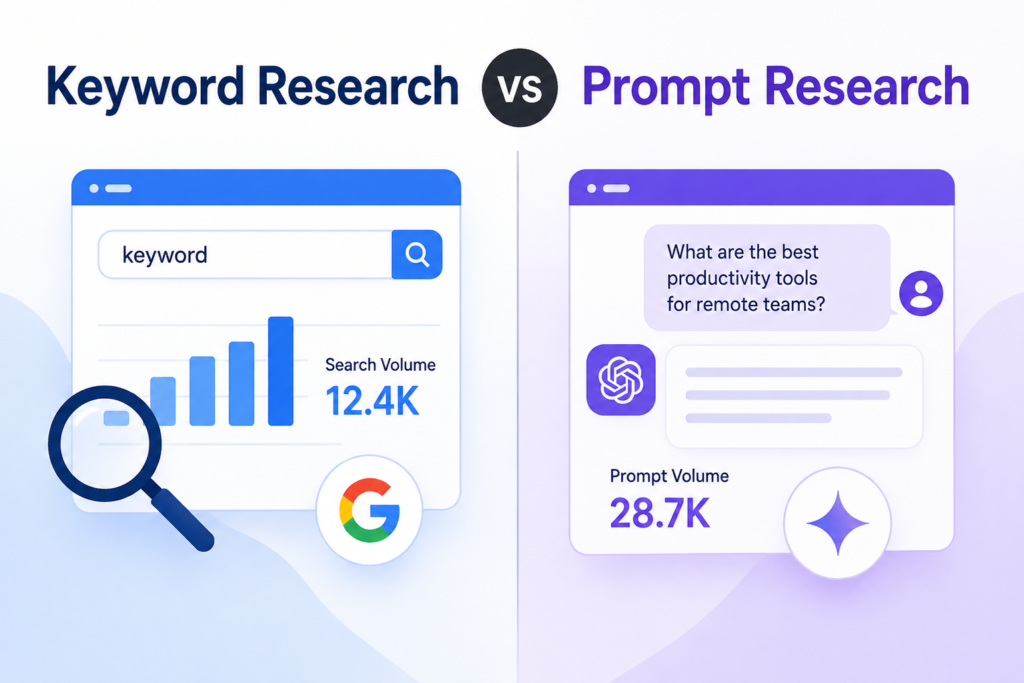
Keyword Research vs Prompt Research, Side by Side
| Keyword Research | Prompt Research | |
|---|---|---|
| What it measures | How often people type a phrase into Google | How often people ask AI assistants about a topic |
| Typical query style | Short phrases (2-5 words) | Full sentences describing a problem |
| Common tools | Google Keyword Planner, Semrush, Ahrefs | Newer AI-prompt tracking tools |
| Best for | Planning classic, rankable webpages | Planning content built to be quoted by AI |
| Blind spot | Misses demand people only ask AI about | Misses demand people only type into Google |
| When to use it | Every topic, as the baseline signal | Alongside keyword data, not instead of it |
Why One Number Alone Isn’t Enough
Here’s the problem: these two numbers often don’t match.
A topic might show low search volume in Google, but a huge amount of AI conversation volume. That means real demand exists, it’s just showing up somewhere keyword tools were never built to see, since people are describing the problem in full sentences to an assistant instead of typing a short phrase into a search box.
The opposite can happen too. A topic might get plenty of Google searches but barely come up in AI conversations at all. That usually means people already know what they’re looking for and just want a quick, familiar search result, not a conversation.
Looking at only one number means missing half the real picture.
The 3 Content Buckets This Creates
1. Strong in Google, Weak in AI Chat
People are searching for this on Google, but they’re not really asking AI assistants about it yet.
For these topics, build a classic, well-structured webpage. Look at what’s already ranking on Google, answer the question clearly and completely, and use clear headings so both readers and search engines can follow along easily.
2. Weak in Google, Strong in AI Chat
This is the group that’s easy to miss if you only check Google search volume.
A topic in this bucket might look small and not worth the effort in a keyword tool. But it turns out plenty of people are asking AI assistants about it in detail, just not typing it into Google as a short phrase.
For these topics, don’t write a typical SEO page. Write clear, direct answers instead, the kind an AI assistant would want to quote back to someone. Think short, confident definitions and straightforward advice, not long buildups before the actual answer.
3. Strong in Both
These are the most valuable topics. People are searching for them in Google and asking AI assistants about them.
Treat these as your best content. Combine both approaches: structure the page well for Google, and make sure the actual answers are clear enough for an AI assistant to quote directly.
A Quick Warning About Blank Results
Sometimes a topic shows no data at all in the AI conversation tools. That doesn’t necessarily mean nobody’s interested.
It often means the topic is too specific, and the AI conversation data is bundled into a bigger, broader topic instead. Before deciding nobody cares about a narrow topic, check the broader subject it belongs to. The real demand might be hiding one level up.
How to Try This Yourself
- Pick your topic list. Start with the subjects you’re already considering writing about.
- Check Google search volume. Use a free tool like Google’s Keyword Planner, or a paid tool like Semrush or Ahrefs.
- Check AI conversation volume. A newer category of tools now tracks this, similar to how keyword tools track Google searches.
- Put both numbers in one simple spreadsheet. One column for Google searches, one column for AI conversations.
- Sort each topic into a bucket. Use the three groups above to decide what kind of content to build, and in what order.
Mistakes That Look Like Strategy
- Judging a topic’s value using only Google search volume, and ignoring AI conversation demand entirely.
- Assuming a topic with zero AI conversation data means nobody’s interested, without checking the broader topic it belongs to.
- Writing the same style of content for every topic, regardless of where the real demand actually shows up.
- Treating one blog post as good enough for a “strong in both” topic instead of investing extra effort into it.
- Never separating Google traffic and AI-assistant traffic in your reporting, which makes it impossible to tell which strategy is actually working.
How Ad2Connect Uses This Approach for Clients
At Ad2Connect, we’ve moved past treating search demand as a single number. Every content plan we build now looks at both traditional search behavior and how people talk to AI assistants about the same topics.
Key Takeaways
- Keyword research and prompt research measure two different things.
- The two numbers often don’t match.
- Topics generally fall into three groups.
- A blank AI conversation result doesn’t mean zero interest.
- The best topics show strong demand in both places.