
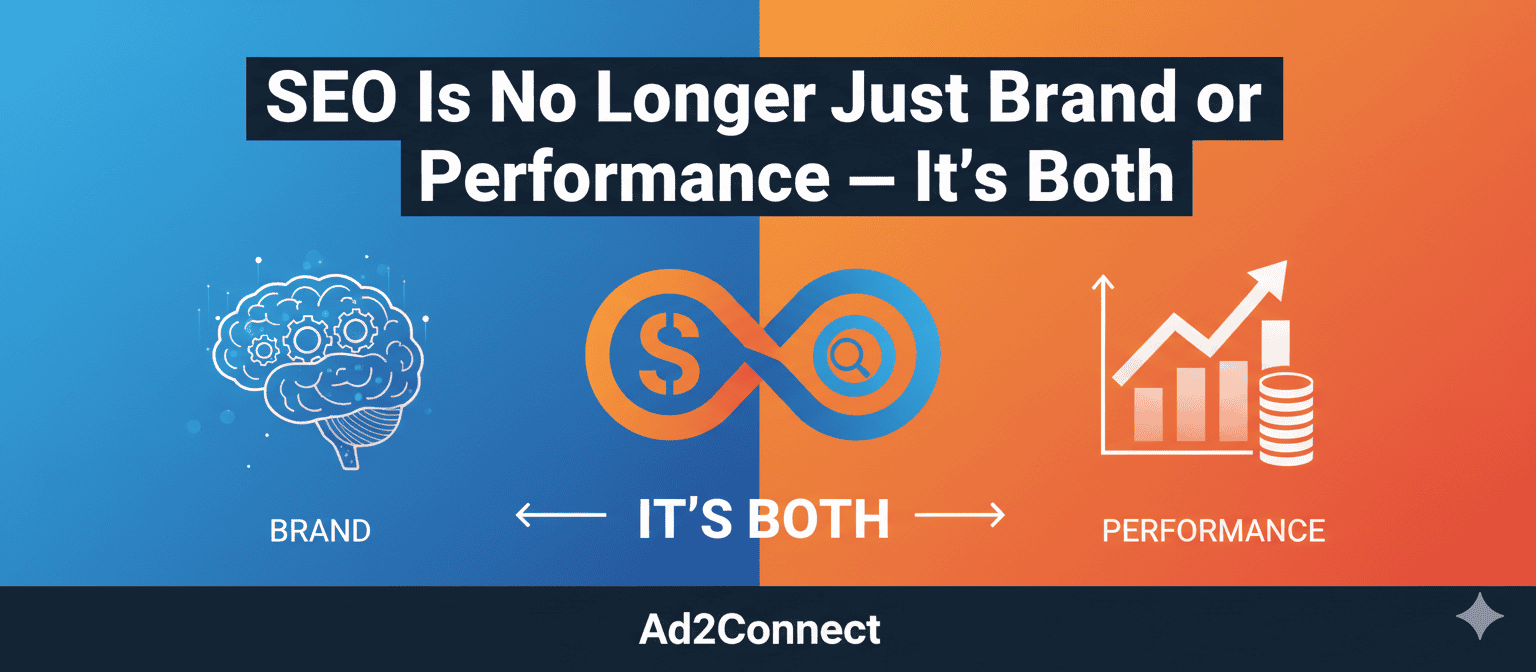
SEO Is No Longer Just Brand or Performance — It’s Both
For over a decade, marketers debated whether SEO should be treated as a branding channel or a performance channel. Brand teams viewed SEO as a long-term trust builder, while growth teams expected it to generate leads and revenue like paid ads.
In today’s search environment, this debate no longer makes sense.
With AI Overviews, entity-based indexing, and user behavior signals shaping rankings, SEO has evolved into a channel that simultaneously builds brand authority and drives measurable business results. It influences how users discover brands, how much they trust them, and whether they convert.
The real question is no longer what kind of channel SEO is, but how to design an SEO strategy that serves both purposes at once.
SEO as a Brand Channel
SEO supports branding by shaping perception before a user ever clicks a product page. Informational content, author credibility, and topical authority all contribute to how search engines and users understand a brand’s role in its industry.
Brand-focused SEO achieves three core outcomes:
- It increases visibility for non-commercial queries.
- It builds topical authority around core subjects.
- It establishes trust signals that influence later buying decisions.
This happens through consistent content coverage, clear entity signals, and recognizable authorship. When a site repeatedly answers questions about a topic accurately and comprehensively, it becomes associated with that topic.
For example, a cybersecurity company publishing in-depth guides on ransomware prevention may not convert visitors immediately, but it builds recognition as a trusted source. When those users later search for enterprise security tools, that brand feels familiar and credible.
In AI-powered search, this effect is amplified. AI summaries prioritize brands that demonstrate subject-matter depth and consistency. Brand SEO is now a ranking factor, not just a marketing side effect.
SEO as a Performance Channel
Performance-driven SEO focuses on outcomes that can be tied directly to business value. These include organic traffic, form submissions, demo bookings, sales, and assisted conversions.
Pages targeting commercial or comparison-based queries play a different role from brand education content. Their goal is not just to inform but to guide users toward action.
Performance SEO succeeds when it matches search intent precisely, provides frictionless user experience, uses persuasive yet helpful content, and supports conversion paths clearly.
A software company ranking for “best project management tool for startups” is capturing high-intent demand. That page is expected to convert. Its success is measured not by impressions but by how many qualified leads it produces.
The mistake many teams make is separating these goals. Brand SEO and performance SEO work best when they reinforce each other.
Why SEO Must Be Both in 2025
Search engines now evaluate content through multiple overlapping lenses, including entity authority, user satisfaction, brand trust, and content usefulness.
This creates a loop. Brand credibility improves rankings. Better rankings increase exposure. Better exposure improves engagement. Engagement strengthens authority.
AI Overviews intensify this relationship by summarizing trusted sources and often removing the need for clicks. Only brands seen as reliable and structured earn consistent visibility.
This means SEO must build authority before conversion, support conversion after authority, and optimize for both machines and humans. Treating SEO as only brand or only performance breaks this loop.
Strategic Framework for Brand and Performance SEO
Build Topical Authority (TEO)
Topical Entity Optimization focuses on owning a subject rather than individual keywords. This is done by organizing content into structured clusters with a clear core theme.
- Create pillar pages for major topics.
- Support them with subtopic articles.
- Link content internally in logical pathways.
- Use consistent terminology across content.
This strengthens brand association with specific subjects and improves AI understanding of expertise.
Optimize for AI Overviews (AIO)
AI search systems prefer content that is easy to summarize and verify. This requires clear section headings, direct answers near the top of pages, neutral tone, and referenced facts.
Summarized sections, short paragraphs, and structured definitions increase the likelihood of inclusion in AI-generated answers.
Improve Conversion Without Sacrificing Trust (CRO and VEO)
Visibility is meaningless if users do not act. SEO pages should guide users naturally toward conversion.
- Place calls to action near decision points.
- Reduce visual clutter.
- Add testimonials and trust indicators.
- Improve load speed and mobile usability.
Visual Engagement Optimization ensures content is readable and scannable, which improves both conversion rates and behavioral signals.
Behavioral SEO Signals
Behavioral SEO measures how users interact with content after clicking.
Important signals include time on page, scroll depth, return visits, and reduced pogo-sticking.
Brand-focused content increases dwell time and loyalty. Performance-focused content increases task completion. Together, they signal usefulness and relevance.
Integrating CIO and MEO
Content Intelligence Optimization uses data to guide what content is created and updated. This includes identifying gaps, refreshing outdated pages, and tracking intent shifts.
Media Entity Optimization focuses on strengthening brand signals through videos, images, and visual assets. Optimized media reinforces topical relevance and improves discoverability.
GEO Strategy for Brand and Performance SEO
Geographic Entity Optimization helps businesses rank locally while maintaining national authority.
- Create location-specific pages.
- Optimize Google Business Profiles.
- Use local schema markup.
- Publish regional case studies.
- Add geo-based testimonials.
This allows multi-location brands to combine local trust with national topical authority.
Alignment With Google Core Updates
This strategy supports experience, expertise, authority, and trust while avoiding thin content, keyword stuffing, and purely promotional pages.
Conclusion
SEO is no longer a single-purpose channel. It builds visibility, authority, trust, and revenue at the same time.
Brands that treat SEO only as traffic generation miss its influence on perception. Brands that treat it only as branding miss its measurable business impact.
If your SEO strategy focuses only on rankings or only on conversions, it is incomplete. Start aligning your SEO with both brand growth and performance outcomes to win in modern search.