
AI vs Google: 37% of Consumers Start Searches With AI
Search Is No Longer a One-Platform Habit
For years, starting a search meant opening Google. That habit is now changing.
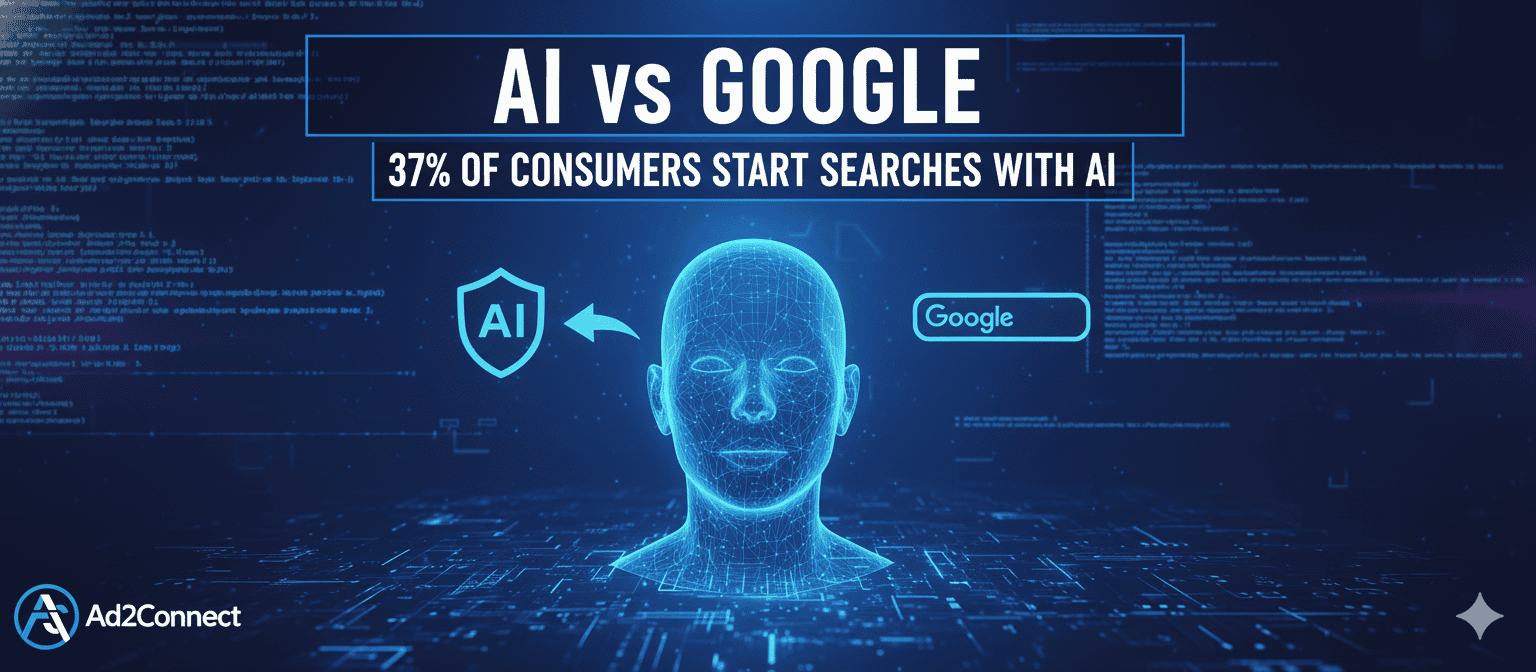
According to a recent study covered by Search Engine Land, 37% of consumers start searches with AI instead of Google. This marks a major shift in how people discover information, research products, and make decisions online.
AI tools are no longer secondary assistants. They are becoming primary discovery engines. For marketers, SEO professionals, and business leaders, this change directly impacts visibility, trust, and long-term growth.
What the Study Reveals About Changing Search Behavior
The study shows that consumers increasingly rely on AI tools at the start of the search journey.
- 37% of consumers now begin searches using AI tools
- AI is commonly used for quick explanations and comparisons
- Users turn to Google later for validation or deeper research
This confirms that AI has become a top-of-funnel discovery channel rather than a supplemental resource.
Why Consumers Are Choosing AI Over Google
1. Faster, Conversational Answers
AI tools deliver direct, summarized responses in natural language. Users can ask follow-up questions instantly, which supports modern Answer Intent Optimization (AIO) and Voice Experience Optimization (VEO).
2. Reduced Cognitive Load
Compared to traditional search results, AI tools eliminate the need to scan multiple links, ads, and snippets. This improves usability, especially on mobile devices.
3. Perceived Trust and Neutrality
Many users feel AI summaries are less biased than ad-heavy SERPs and better at synthesizing information across multiple sources.
AI Search vs Google Search: A Comparison
| Feature | AI Search Tools | Google Search |
|---|---|---|
| Result format | Direct, summarized answers | List of links |
| User interaction | Conversational | Click-based |
| Speed | Immediate | Requires scanning |
| Ads presence | Minimal | Prominent |
| Best use case | Early discovery | Validation and depth |
What This Shift Means for SEO in 2025 and Beyond
The reality that 37% of consumers start searches with AI instead of Google expands how we define SEO visibility.
- Being referenced or summarized by AI tools
- Appearing in AI Overviews
- Influencing conversational answers
This evolution introduces Language Engine Optimization (LEO) and Conversational Interface Optimization (CIO) alongside traditional SEO.
How Marketers Can Adapt to AI-First Discovery
Actionable Strategies
- Optimize for semantic and entity-based SEO
- Structure content with clear headings and lists
- Strengthen E-E-A-T signals through expertise and citations
- Align content with UX, CRO, and mobile-first principles
AI systems favor content that is factual, well-structured, and genuinely helpful.
Impact Beyond SEO: PPC, Social, and Measurement
- PPC: Fewer early-stage searches may trigger ads
- SMO: Thought leadership and brand mentions gain influence
- Measurement: Attribution becomes more complex as discovery shifts
Conclusion: AI and Google Now Share the Search Journey
The fact that 37% of consumers start searches with AI instead of Google confirms that search behavior is evolving.
AI tools are shaping early discovery, while Google continues to support deeper exploration. Brands that focus on clarity, trust, and real value will stay visible across both AI-driven and traditional search environments.