

How to De-Risk SEO Strategy When Google Keeps Changing the Rules
Your rankings can drop even if you never touched your website. That’s not bad luck, it’s how modern search actually works. Here’s how to build a strategy that holds up anyway, explained simply.
By Snehal Singh | Published: August 5, 2026
AI Overview Summary
Google’s search rankings used to depend mostly on fixed factors like keywords and links. Today, they’re shaped by real-time machine learning systems that react to competitor changes, world events, and how people actually behave on a page. That means rankings can shift even when a website hasn’t changed at all. De-risking your SEO strategy means building a website that stays strong regardless of these shifts, through solid technical setup, genuinely useful content, a good user experience, and honest link building, while avoiding shortcuts that produce quick wins but leave a site exposed to sudden penalties.
Table of Contents
- Why Rankings Move Even When You Don’t Change Anything
- What Actually Causes Ranking Swings
- The 4 Pillars of a De-Risked SEO Strategy
- Why You Shouldn’t Rely on Google Alone
- Low-Risk vs High-Risk Tactics
- Mistakes That Look Like Strategy
- How Ad2Connect Builds Resilient SEO for Clients
- Key Takeaways
- FAQ: De-Risking Your SEO Strategy
Why Rankings Move Even When You Don’t Change Anything
Years ago, ranking well on Google was fairly simple. Use the right keywords. Write solid content. Build up some links. That was mostly it.
That approach doesn’t fully work anymore. Google’s ranking systems now run on machine learning models. They react and adjust constantly, almost like a living system rather than a fixed checklist.
A few things now move your rankings that have nothing to do with your own website. Competitors improving their own pages can quietly push you down, even if yours stayed exactly the same.
Big world events or shifts in how people search can cause Google to update results in ways nobody could have predicted. Google increasingly watches how real users behave too, adjusting rankings based on whether visitors seem satisfied or not.
None of this means SEO is hopeless. It means the goal has changed. Instead of chasing a perfect one-time checklist, the real job now is building a site that holds up well no matter which way the wind blows.
What Actually Causes Ranking Swings
Beyond the deeper shifts in how Google’s systems work, a few specific, common triggers explain most day-to-day ranking movement:
- Broad algorithm updates. Google regularly adjusts its core systems, and many of these changes are never officially announced.
- New search result features. Things like AI Overviews change how many clicks actually reach a website, even for pages that still rank well.
- Small site changes adding up. Minor, scattered edits to page structure or metadata can quietly hurt ranking stability over time.
- Link profile changes. Links naturally fade in value over time. Sudden gains or losses in link quality can shift a page’s perceived authority.
- Competitor activity. A rival investing in better content or a stronger user experience can displace your rankings without you doing anything wrong at all.
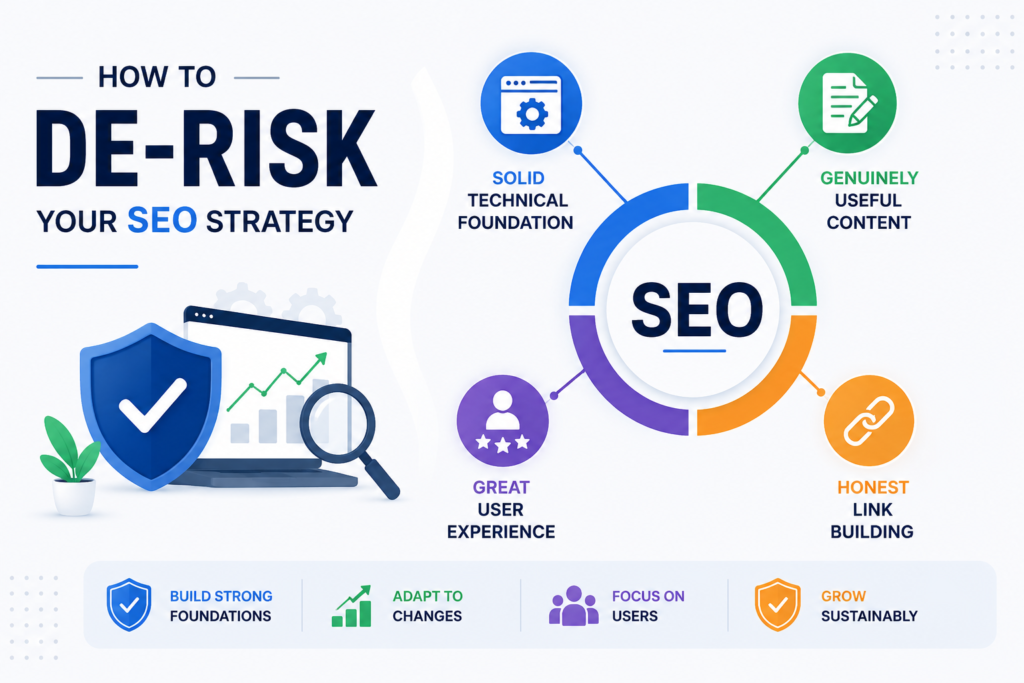
The 4 Pillars of a De-Risked SEO Strategy
1. Solid Technical Foundation
If Google’s crawlers can’t properly access and read your website, nothing else matters. Three basics cover most of it.
Make sure nothing is accidentally blocking Google from your pages. Make sure pages load quickly without a frustrating experience. Make sure your actual content is easy for Google to find and read.
Running regular technical checks catches most issues early. Waiting for traffic to drop before investigating costs valuable time.
2. Genuinely Useful Content
Modern search systems reward content that shows real expertise and firsthand knowledge. Generic summaries anyone could write don’t hold up as well. That means involving people who actually know the subject in creating or reviewing content.
AI tools can help with research and organizing ideas. But publishing AI-written pages without real human review creates real risk.
It’s also smart to cover a topic from a few different angles. Search intent can shift over time, and a page built for only one angle can lose visibility overnight if that happens.
3. A Genuinely Good User Experience
Google pays close attention to how real people behave once they land on a page. If visitors leave quickly and go back to search results, that’s treated as a signal something’s wrong.
A few practical fixes help here. Make sure a page actually satisfies what someone was searching for. Keep the mobile experience clean and free of intrusive pop-ups. Improve load speed. Use clear navigation so people can easily find what they need.
4. Honest, Earned Link Building
Building links the honest way still matters. But the old-school approach of chasing as many backlinks as possible has become genuinely risky.
A stronger, more durable approach focuses on a few things: earning coverage from real publications, creating original research or data other people want to reference, and building a real reputation within your industry.
Why You Shouldn’t Rely on Google Alone
Google isn’t the only place people go to find things anymore. Betting everything on organic search rankings leaves a business exposed if those rankings ever dip.
Spreading visibility across email newsletters, social platforms, and AI-powered search tools like ChatGPT gives a business something to fall back on. If Google traffic ever wavers, these other channels keep things running.
Tracking performance closely matters just as much. Without clear monitoring of traffic and conversions, it’s nearly impossible to tell what actually caused a drop.
Low-Risk vs High-Risk Tactics
| Risk Level | What It Looks Like | The Trade-Off |
|---|---|---|
| Low risk | Genuine content, honest link earning, solid technical SEO | Slower results, but safe from penalties |
| Moderate risk | Aggressive but not outright deceptive tactics that push policy boundaries | Faster growth, but vulnerable to future algorithm changes |
| High risk | Manipulative tactics like thin AI-mass-produced content, hidden text, or fake reviews | Quick short-term gains, high chance of a serious penalty |
Tactics in the high-risk column include a few common patterns. Publishing large volumes of low-value AI or scraped content. Hiding text or links from real visitors while showing them to search engines. Faking product reviews through manipulated structured data. Buying old, unrelated domains just to exploit their existing authority.
All of these can work briefly. All of them tend to end the same way: a sharp, painful drop once they’re caught.
Mistakes That Look Like Strategy
- Chasing quick ranking wins through manipulative tactics instead of building something durable.
- Publishing AI-generated content at scale with no real human review or expertise behind it.
- Treating technical SEO as a one-time setup instead of something checked regularly.
- Relying entirely on Google traffic with no other channels to fall back on.
- Ignoring user experience signals like page speed and mobile usability until rankings already start slipping.
How Ad2Connect Builds Resilient SEO for Clients
At Ad2Connect, we build SEO strategies designed to hold up through algorithm changes. Not just perform well for one quarter.
That means solid technical work, genuinely useful content, real user experience improvements, and honest link building, all working together. No single piece carries the whole strategy alone.
This connects directly to our other guides on the same theme. Real expertise beats shortcuts, which is the same point we make in AI and human expertise in SEO, and unresolved technical issues quietly compound the way we describe in technical SEO debt. It’s all part of a broader SEO approach built to survive the next update, not just the current one.
If your traffic has been volatile lately and you’re not sure why, that’s usually a sign it’s time to check all four pillars, not just chase the most recent Google update.
Key Takeaways
- Modern rankings shift based on machine learning systems, competitor activity, and user behavior, not just your own website’s content.
- A resilient SEO strategy rests on four pillars: solid technical setup, genuinely useful content, good user experience, and honest link building.
- Relying only on Google traffic is risky. Diversify into email, social, and AI-powered search tools as backup channels.
- Not all SEO tactics carry equal risk. Understand where a tactic falls before committing resources to it.
- Manipulative shortcuts tend to end the same way: a sharp drop once they’re caught, often worse than the gains they produced.